


Contents
1.0
Introduction
This Module establishes the requirements associated with the use of feedstocks as a part of carbon dioxide removal Projects. This includes setting out criteria for feedstocks in relation to sustainability, counterfactual storage and market leakage. This Module also provides methods for the quantification of counterfactual storage and market leakage to determine eligible feedstocks. This Module is currently applicable to the following feedstocks:
- Forestry residues1 and downstream wood processing residues2
- Agricultural residues
- Industrial residues
- Municipal wastes
- Invasive species
Every Project Proponent must consider specific alternative uses of feedstocks that would have occured in the absence of the Project. The baseline scenario must be considered relative to each feedstock used if the Project utilizes multiple feedstock types, in line with Section 2.5.2 of the Isometric Standard. If a Project uses any feedstock that is deemed ineligible by this Module, this feedstock will not count towards Crediting. If a Project utilizes ineligible biomass for alternative uses in excess of 25% of the feedstock mass in a given Reporting Period, removals within the Reporting Period will not be Credited by Isometric.
The current approach outlined in this Module provides:
- Sustainable sourcing criteria that aim to ensure feedstocks are sourced without threatening the sustainability of the upstream resource.
- Counterfactual storage criteria that aim to ensure removals provide near-term climate benefits.
- Market leakage criteria that aim to assess the full emissions impact and additionality of feedstock use while accounting for limited data availability in some feedstock sourcing scenarios.
1.1
Future Versions
This Module was developed based on the current state of the art and publicly available science regarding sourcing biomass for Biomass Carbon Removal and Storage (BiCRS) Projects. This Module is based in part on the most up-to-date literature and models at the time of publication. This Module will continue to be updated as scientific and economic understanding develops.
Future work to include additional feedstocks, such as purpose-grown BiCRS feedstocks, will be undertaken as necessitated by demand, and as enabled by improved research and modeling.
This Module will be reviewed on an annual cadence in line with the Isometric Standard.
2.0
Feedstock Eligibility
The framework outlined in this Module sets out sourcing criteria that qualify feedstocks as eligible for use in BiCRS Projects in a way that ensures sustainable sourcing and accounts for the emissions impacts that result from market leakage. These considerations vary based on the characteristics and sourcing activities of the feedstock.
Feedstock eligibility requires the Project Proponent to demonstrate that the feedstock complies with the Sustainability Criteria (Section 2.1) and the Prohibited Feedstock Criteria (Section 4.1) to establish eligibility. Eligible feedstocks must then undergo further evaluation to assess their counterfactual storage (Section 3) and market leakage (Section 4.2) values. Guidance of how to use this document can be seen in Figure 1 below.

- Sustainability Criteria: Requirements to ensure that feedstock sourcing is sustainable. These criteria are reviewed every Reporting Period. See Section 2.1 for details.
- Counterfactual Storage: Counterfactual storage considers the CO2e stored in the feedstock that would have remained durably stored in absence of the Project activities. This feedstock fraction does not count towards Crediting. Counterfactual storage assessments are valid for 10 years. See Section 3 for details.
- Prohibited Feedstocks: Some feedstocks are deemend ineligible for crediting under this Module. This is due to the significant risk of market leakage associated with sourcing these feedstocks. This applies to feedstocks that meet the other criteria outlined within this module. Feedstocks such as food/feed crops and purpose grown BiCRS feedstocks are not detailed here as they have no path through the Module. Feedstocks must meet one of the criteria within this section to establish the feedstock as eligible. See Section 4 for details.
- Market Leakage: Increased demand for a feedstock driven by sourcing by a Project Proponent may cause market changes that increase GHG emissions through additional activities to replace feedstock services, or changes in market supply leading to land-use change or other market shifts. Market leakage assessments are valid for 10 years. See Section 4 for details.
2.1
Sustainability Criteria
For use by a Project Proponent for Crediting, feedstock sourcing must be deemed sustainable. The following section outlines how a Project Proponent is required to assess whether their feedstock sourcing is sustainable and provide evidence of sustainability for their feedstock type. In some instances, sustainability criteria also include an evaluation of market leakage (e.g., SC5.1).
The following information must be submitted as part of the verification for each Reporting Period:
- The Project Proponent must establish sustainable sourcing practices for the Sustainability Criteria relevant to their feedstock type. A feedstock must satisfy all criteria associated with the feedstock type (e.g., SC1.1 and SC1.2 and SC1.3 for forestry residues). Sustainability Criteria must be determined for each Reporting Period. This means that for each claimed removal the Project Proponent must either produce new evidence that the relevant Sustainability Criteria are met or ensure existing evidence is up-to-date.
| Table 1 | ||
|---|---|---|
| SC1: Forestry Residues and Downstream Wood Processing Residues | ||
| Criteria | Documentation Required | |
| SC1.1 | The feedstock must be sourced from an approved forestry certification or management program listed in Table 6 or from a region subject to a equivalent risk assessment. | The Project Proponent must provide all of the following: Evidence that the feedstock is sourced from an area or entity under a listed certification or management program, including evidence of the certification applicability and change-of-custody. Where this cannot be evidenced, in consultation with Isometric, the Project Proponent must provide an independent, third-party, risk based determination of low risk that a feedstock from the sourcing area is non-compliant with the principles equivalent to those considered by the programs listed in Table 6. Any additional documentation as required in Table 6. |
| SC1.2 | The feedstock must be sourced from an area of stable or increasing forest carbon stocks unless sourced as part of a government mandated, managed or otherwise supported wildfire mitigation program. Exceptions will be evaluated on a case-by-case basis considering a range of ecosystem and economic factors. | The Project Proponent must provide one of the following: An independent third-party assessment that demonstrates the forest carbon stocks encompassing the sourcing region3 has not experienced a net decrease over the last 5 years compared to the 5 years previous to that. Where this assessment cannot be provided, the following may be considered: Evidence that the average LULUCF of the state/country does not exceed the regeneration of the forest carbon stocks over the last 5 years. This is demonstrated if the net emissions are zero or under, as reported in the UNFCCC. In countries where the harvesting exceeds 5 million km2, additional evidence that forest carbon stocks have not decreased over the previous 10 years is required. Evidence that the feedstock was sourced by, or to meet the clear goals of, a government mandated, managed or otherwise supported wildfire mitigation program, including evidence of program participation and chain-of-custody. |
| SC1.3 | The feedstock must not be sourced from a primary forest4, unless sourced as part of a government mandated, managed or otherwise supported wildfire mitigation program. | The Project Proponent must provide one of the following: Evidence of the sourcing location using chain-of-custody documentation to demonstrate an absence of sourcing from primary forests. Evidence that the feedstock originates from a government mandated, managed or otherwise supported wildfire mitigation program, including evidence of program participation and chain-of-custody. |
| SC2: Retrofits Using Forestry Residues and Downstream Wood Processing Residues | ||
|---|---|---|
| Criteria | Documentation Required | |
| SC2.1 | The feedstock must be sourced from an approved forestry certification or management program listed in Table 6 or Table 7 or from a region subject to a equivalent risk assessment. | The Project Proponent must provide all of the following: Evidence that the feedstock is sourced from an area or entity under a listed certification or management program, including evidence of the certification applicability and chain-of-custody. Where this cannot be evidenced, in consultation with Isometric, the Project Proponent must provide an independent, third-party, risk based determination of low risk that a feedstock from the sourcing area is non-compliant with the principles equivalent to those considered by the programs listed in Table 6 or Table 7. Any additional documentation as required in Table 6 or Table 7. |
| SC2.2 | The Baseline Feedstock Consumption Rate and associated feedstock sourcing for the facility must be demonstrated. | The Project Proponent must provide one of the following: Evidence of the facility feedstock input data, including feedstock sourcing and quantity, for the previous 5 years prior to the installation of retrofit infrastructure. Evidence that the Baseline Emission Rate is greater than the Maximum Biogenic Carbon Utilization Rate (See Appendix 4 for details) and evidence of any feedstocks sourced to meet the parasitic load energy demands/reductions in primary output and how these are accounted for. |
| SC2.3 | Any feedstock that is sourced over the Baseline Feedstock Consumption Rate must adhere to SC1 in order to be eligible for Crediting (See Appendix 4 for details). This includes any material sourced to meet the parasitic energy load or reductions in primary output that result from the retrofit infrastructure. Projects that cannot satisfy this criteria are still eligible for crediting for removals corresponding to the baseline feedstock. | The Project Proponent must provide one of the following: Evidence that there is no change to the feedstock sourcing behavior of the facility. Evidence demonstrating that the excess feedstock is assessed as a separate feedstock adhering to SC1. Evidence of the quantity of excess ineligible feedstock sourced over the Baseline Feedstock Consumption Rate and a demonstration of how this will be subtracted from gross removals. Evidence that the Baseline Emission Rate is greater than the Maximum Biogenic Carbon Utilization Rate (See Appendix 4 for details) and that sufficient feedstocks to meet the parasitic load energy demands/reductions in primary output are assessed as a separate feedstock adhering to SC1. |
| SC3: Crop Residues | ||
|---|---|---|
| Criteria | Documentation Required | |
| SC3.1 | The feedstock must not be sourced from land converted to agriculture in the past 5 years. | Evidence that the sourcing region has been agricultural land for at least 5 years prior to the Project's first procurement date. This must be demonstrated through historical crop plans, output records or remote sensing. |
| SC3.2 | The feedstock must not be sourced from the same acreage in consecutive years unless monocropping can be demonstrated for the previous 5 years. | The Project Proponent must provide one of the following: Feedstock purchase contracts between the Project Proponent and the feedstock supplier. The output/utilization data of the acreage for 5 years prior to the Project's first procurement data. |
| SC4: Animal Agriculture Residues | ||
|---|---|---|
| Criteria | Documentation Required | |
| SC4.1 | The feedstock is not sourced above the Baseline Feedstock Generation Rate (See Appendix 4 for details). | Data from 2 years prior to the Project's first procurement date demonstrating the Baseline Feedstock Generation Rate and the proposed mass to be procured by the Project Proponent. |
| SC5: Food Processing, Landscaping or Other Industry Residues | ||
|---|---|---|
| Criteria | Documentation Required | |
| SC5.1 | The feedstock must be represented in Appendix 5 or be determined to be similarly low in market leakage risk, based on a case-by-case review. | Evidence of feedstock characteristics. |
| SC5.2 | The feedstock must not be sourced above the Baseline Feedstock Generation Rate (See Appendix 4 for details). | Data from 5 years prior to the Project's first procurement date demonstrating the Baseline Feedstock Generation Rate and the proposed removal rate by the Project. |
| SC6: Municipal Waste | ||
|---|---|---|
| Criteria | Documentation Required | |
| SC6.1 | The feedstock must be designated as a municipal waste5. | Evidence that the feedstock was obtained, produced or diverted from a municipal waste facility. This could include evidence of waste classification and a site waste permit, or a waste management contract with a local authority. |
| SC6.2 | The feedstock must have undergone demonstrable, high-quality pretreatment, including sorting and processing to ensure only unrecoverable residues remain. | The Project Proponents must provide one of the following: Evidence of sufficient pretreatment of the feedstock as defined in the EU Waste Framework Directive. This must include sorting and thermal, mechanical, chemical or biological treatment depending on the waste constituents. A signed affidavit from the feedstock supplier, and evidence of waste constituents, demonstrating the act of pretreating the waste would not have an environmental or economic benefit. This can include cases where the waste has been sorted at source. |
| SC7: Invasive Species | ||
|---|---|---|
| Criteria | Documentation Required | |
| SC7.1 | The feedstock sourcing must include sufficient safeguards to ensure there is a low risk of spreading the invasive species to other ecosystems. | Evidence of the harvest plan for the invasive species detailing approaches to ensure the risk of spreading is minimized. |
| SC7.2 | The feedstock sourcing must be part of a broader ecosystem management activity taken by local, state or federal governments, non-profit organizations or private landowners. | The Project Proponent must provide all of the following: Evidence of the invasive species (native or non-native) classification by an authority for the feedstock to be sourced. Documentation of management activities for the purpose of invasive species removal. |
3.0
Counterfactuals
When feedstocks are used for BiCRS Projects, each eligible unit of stored carbon will be Credited as CO2e. However, not all removed and stored carbon is considered environmentally additional from a climate impact perspective. To accurately determine a Project's climate impact, the Project Proponent must assess if the feedstock's biogenic carbon would have been released into the atmosphere in the near term (e.g., through burning or rapid decay), termed , or if this carbon would have remained stored longer, termed . Only the fraction that would have been emitted in the absence of the Project activities will be Credited as an environmentally additional removal.
Accounting for counterfactual storage ensures Credits accurately reflect the Project's actual climate impact, preventing overstatement of removals by accounting for carbon that would have stayed out of the atmosphere for long periods regardless of the Project's intervention. This is also to ensure Project activities have a measurable impact in mitigating near-term climate change and to incentivize the use of feedstocks with the most near-term impacts.
3.1
Counterfactual Fate Evidencing Requirements
Project Proponents must demonstrate that the counterfactual fate has been properly assessed and the counterfactual storage has been appropriately quantified. Once a feedstock's counterfactual fate has been established, it's determined fate is valid for 10 years provided the feedstock sourcing does not change. Under exceptional circumstances where Isometric identifies a significant change to the understood counterfactual fate, Isometric reserves the right to conduct an audit to ensure feedstocks continue to meet the criteria laid out in this Module. Typically the historical fate of the feedstock is a good indicator of the future counterfactual fate of the feedstock absent the Project activities. To assess the counterfactual fate of the feedstock, at least one of the following pieces of evidence must be provided by the Project Proponent:
- Historical evidence of the counterfactual fate of the feedstock over the last 5 years provided by the feedstock supplier.
- Purchase records or a contractual clause in purchase records confirming the counterfactual fate of the feedstock over the last 5 years.
- An assessment of the expected fate over the last 5 years of the feedstock given the most economically viable option in a given sourcing area, including all data, documentation and assumptions used.
- Retrofits using feedstocks at or below the Baseline Feedstock Consumption Rate can evidence the counterfactual as the pre-retrofit scenario over the last 5 years (e.g., combustion with emissions released for bioenergy projects). See Appendix 4 for more details.
- In some cases, an affidavit from the feedstock supplier confirming the counterfactual fate of the feedstock may be considered.
3.2
Counterfactual Criteria
All feedstocks eligible for crediting must meet one of the criteria listed in Table 2 to evaluate counterfactual storage.
| Table 2 | ||
|---|---|---|
| Counterfactual Criteria | ||
| Criteria | Documentation Required | |
| CC1 | Project feedstock harvesting activities will increase ecosystem carbon sequestration over 15 years by an amount equal to or greater than the carbon in the feedstock. The of these feedstocks is 0. | The Project Proponent must provide documentation detailing the current counterfactual and Project-affected (15 year) ecosystem carbon sequestration from feedstock collection as well as an ongoing monitoring plan to ensure ecosystem carbon sequestration takes place. |
| CC2 | Feedstock is sourced through a government managed, funded or otherwise supported wildfire mitigation program. The of these feedstocks is 0. | The Project Proponent must provide evidence that the feedstock originates from a government mandated, managed or otherwise supported wildfire mitigation program, including evidence of program participation and chain-of-custody. |
| CC3 | The of the feedstock is quantified (See Section 3.3 for details). | The Project Proponent must provide a quantification of including all documentation, data-sets, references and assumptions associated with the calculation of counterfactual storage. |
3.3
Counterfactual Storage Calculation Requirements
Feedstocks that do not meet CC1 or CC2 within Table 2 must quantify counterfactual storage. Biogenic carbon that would likely be stored in the biomass for the next 15 years in the counterfactual is considered counterfactually stored.
Counterfactual storage is a quantified measurement of stored biogenic carbon, and takes into account the amount of biogenic carbon within the feedstock and the emissions associated with the release of the biogenic carbon.
Biomass decay that would lead to additional carbon storage in the landscape is taken into account (e.g., soil organic carbon gains from biomass decay). This effect may be nonlinear and Project Proponents can provide evidence of its negligibility at the feedstock removal rates.
Counterfactual storage is reported in CO2e units. Counterfactual emissions are evaluated as the CO2e using the 100-year Global Warming Potential (GWP), GWP100, of all released GHGs within 15 years. The most recent volume of the IPCC Assessment Report should be used (currently the Sixth Assessment Report) to represent the GWP100 of GHGs.
If all stored biogenic carbon within the feedstock would be emitted within 15 years in the counterfactual, then = 0. If CO2e emissions within 15 years exceed the equivalent stored biogenic carbon within the feedstock at 15 years, counterfactual storage can be quantified by the amount of biogenic CO2e that is stored after 50 years. This is to increase the eligibility of feedstocks that have a disproportionately large near-term release of GHGs with a GWP100 >1 in the counterfactual. Example calculations can be found in Appendix 6.
Equation 1 and equation 2 must be used to quantify the total CO2e that is ineligible for Crediting.
(Equation 1)
(Equation 2)
Where:
- - The mass of biogenic carbon that is ineligible for crediting, in tonnes of CO2e, for batch .
- - The mass of biogenic carbon within the feedstock, in tonnes of CO2e, for batch .
- - The mass of biogenic carbon eligible to count towards gross removals, in tonnes of CO2e, for batch .
- - The mass of CO2e emissions that would be emitted from the feedstock in the counterfactual within 15 years, for batch .
- - The mass of biogenic carbon within the feedstock that would remained stored in the counterfactual after 50 years, in tonnes of CO2e, for batch .
For each Reporting Period, must be aggregated across all feedstock batches, where is the total number of batches:
(Equation 3)
Where:
- - The total mass of biogenic carbon that is ineligible for crediting, in tonnes of CO2e.
4.0
Market Leakage Emissions
Sourcing feedstocks for the purpose of BiCRS Projects can lead to an increase in GHG emissions resulting from changes to the supply and demand equilibrium, also called market leakage. For example, the sourcing of a feedstock above the Baseline Feedstock Generation Rate could lead to increased feedstock production (e.g., land use change). This can also occur when removed feedstocks exceed the Sustainable Usage Rate, leading to demand for a replacement product (e.g., fertilizer). Feedstocks that do not meet the criteria established in Table 3 are deemed ineligible under the current Module due to high risks of significant market leakage. Market leakage must be evaluated in all cases using the criteria within Table 4.
Once a Project's feedstock is identified as eligible, it maintains it's eligibility for a period of 10 years provided the feedstock sourcing does not change. Under exceptional circumstances where Isometric identifies a significant risk of substantial market leakage, Isometric reserves the right to conduct an audit to ensure feedstocks continue to meet the criteria laid out in this Module.
The following information must be submitted every 10 years:
- Project Proponents must demonstrate that feedstocks adhere to one of the criteria within Table 3 to be eligible under this Module.
- Project Proponents must demonstrate that feedstocks adhere to one of the criteria within Table 4, to evidence that market leakage has been evaluated. In cases where the feedstock is not considered to generate market leakage, evidence must be provided against the relevant criteria to demonstrate 0 market leakage emissions.
4.1
Prohibited Feedstocks
Certain feedstocks are deemed ineligible by this Module due to the associated high risk of significant market leakage. These include cases where the feedstock was cultivated for the purpose of food, feed, energy or use in BiCRS as well as materials used in long-lived wood products such as construction materials and furniture. There are exceptions under specific circumstances. To establish feedstock eligibility, the feedstock must meet the relevant criterion outlined in Table 3.
| Table 3 | ||
|---|---|---|
| Prohibited Feedstocks | ||
| Criteria | Documentation Required | |
| PF1 | Applicable to non-woody feedstocks: The feedstock must not have been produced for bioenergy applications. This does not affect the use of residues that have fulfilled their purpose for energy generation (e.g., post anaerobic digestion manure). | The Project Proponent must provide evidence that the feedstock was not produced for bioenergy use for 2 years prior to the Project's first procurement date. |
| PF2 | Applicable to woody feedstocks: The feedstock must not be suitable for use as a component of long-lived wood products or pulpwood (e.g, construction materials, furniture, fiberboard etc.). Feedstocks that have fulfilled their use as long-lived wood products or pulpwood are eligible if they cannot be further repurposed. Residues from wood processing are eligible if non-marketable or marketed only for bioenergy, landscaping or mulch over the previous 2 years. | The Project Proponent must provide evidence of the feedstock lifecycle including generation and utilization/disposal for 2 years prior to the Project's first procurement date. Feedstocks sourced from wildfire mitigation programs are exempt from this requirement if the Project Proponent can provide evidence that the feedstock was sourced by, or to meet the clear goals of, a government supported wildfire mitigation program, including evidence of program participation and chain-of-custody. |
4.2
Evaluating Market Leakage
All feedstocks must select a market leakage assessment and meet all criteria within the selected assessment as laid out in Table 4 (e.g., ML5.1 and ML5.2) for the evaluation of market leakage emissions, termed .
| Table 4 | ||
|---|---|---|
| ML1: Quantify Market Leakage | ||
| Criteria | Documentation Required | |
| ML1.1 | The of the feedstock is quantified (See Section 4.3 for details). | The Project Proponent must quantify the emissions associated with market leakage and provide the documentation used in this quantification including references, data-sets and assumptions. |
| ML2: CCS retrofits where baseline facility emissions exceed capture capacity. For feedstocks that meet both of the following criteria, . | ||
| Criteria | Documentation Required | |
| ML2.1 | The Maximum Biogenic Carbon Utilization Rate of the CCS infrastructure does not meet or exceed the Baseline Emission Rate. This criteria allows for the qualification of a feedstock mass that does not exceed the Maximum Biogenic Carbon Utilization Rate, after subtracting both the Baseline Emission Rate and any parasitic load of the retrofit infrastructure. All values are expressed in feedstock equivalent units. | Documentation demonstrating the Baseline Emission Rate over the last 5 years and an evidenced calculation of the Maximum Biogenic Carbon Utilization Rate of the CCS infrastructure (See Appendix 4 for calculation requirements). |
| ML2.2 | All feedstock sourced outside the baseline, including any feedstock sourced to meet parasitic energy requirements or reductions in the facility's primary outputs, must be accounted for under another market leakage criteria. | A quantification of the parasitic load, and/or any decrease in the primary output of the facility due to the retrofit infrastructure and evidence of how this is accounted for. |
| ML3: Retrofit baseline feedstocks. For feedstocks that meet both of these criteria, . | ||
| Criteria | Documentation Required | |
| ML3.1 | The facility feedstock consumption remains consistent in mass and sourcing compared to the pre-retrofit baseline. | A quantification of the Baseline Feedstock Consumption Rate for the facility for 5 years prior to the retrofit installation (See Appendix 4 for calculation requirements). |
| ML3.2 | All feedstock sourced outside the baseline, including any feedstock sourced to meet parasitic energy requirements or reductions in the facility's primary outputs, must be accounted for under another market leakage criteria. | A quantification of the parasitic load, and/or any decrease in the primary output of the facility due to the retrofit infrastructure and evidence of how this is accounted for. |
| ML4: The Project Proponent does not contribute significantly to the revenue of the feedstock supplier. For feedstocks that meet this criteria, . | ||
| Criteria | Documentation Required | |
| ML4.1 | The Project Proponent must demonstrate one of the following: There was no payment made to the feedstock supplier for the feedstock. The payment made to the feedstock supplier is equal to or lower than the recovery, transportation and replacement costs6. The Project Proponent was paid for the removal of the feedstock, such as a tipping fee. The Project Proponent paid a third party, whose sourcing activities also adhere to one of the above. | The Project Proponent must provide one of the following: Purchase/removal records between the Project Proponent and the feedstock supplier demonstrating the price paid and evidence of how this adheres to this criteria. A signed affidavit from the third party and/or feedstock supplier that the third party is not providing payment exceeding the recovery, transportation and replacement costs. |
| ML5: There is an excess supply of feedstock with an economic purpose. For feedstocks that meet both of the following criteria, . | ||
| Criteria | Documentation Required | |
| ML5.1 | The feedstock is demonstrated to serve an economic purpose7 and the Project Proponent can demonstrate a local supply excess (e.g., stable or growing stockpiles), that the Project won't exceed. | The Project Proponent must provide all of the following: Historical contracts between the feedstock supplier and the end-use/disposal sites. A quantification of the Baseline Feedstock Generation Rate over the previous 5 years (See Appendix 4 for details). Where this detail is unavailable, an affidavit from the feedstock supplier demonstrating the historical fate of the feedstock may be considered, subject to third-party verification (e.g., a VVB). |
| ML5.2 | The Project Proponent must demonstrate the price paid to the feedstock supplier was not significant, leading to increased production. This must be demonstrated by one of the following: A demonstration that the price paid to the feedstock supplier for the feedstock does not exceed 5% of the total revenue generated from the feedstock supplier's operations. A demonstration that the price paid to the feedstock supplier does not exceed 2x the cost the feedstock supplier would have paid for disposal. A demonstration that the price paid to the feedstock supplier for the feedstock is less than 5% of the total benchmark-priced revenue. This revenue is derived from all marketed products and calculated per unit of residue produced. | The Project Proponent must provide one of the following: Purchase/removal records between the Project Proponent and the feedstock supplier demonstrating the price paid and evidence of how this adheres to this criteria. Evidence of all marketed products associated with the feedstock production, a quantification of marketed products production per unit of feedstock and an evidenced price point for the sum of the products produced. Where this detail is unavailable, an affidavit from the feedstock supplier that documents payments made for the feedstock by the Project Proponent do not constitute a large share of upstream operations revenue. |
| ML6: Excess residue productions with no economic purpose. For feedstocks that meet both of the following criteria, . | ||
| Criteria | Documentation Required | |
| ML6.1 | The feedstock is demonstrated to serve no economic purpose and the Project Proponent will not use the feedstock above the Baseline Feedstock Generation Rate. | The Project Proponent must provide all of the following: Historical contracts between the feedstock supplier and the end-use/disposal sites. A quantification of the Baseline Feedstock Generation Rate over the previous 5 years (See Appendix 4 for details). Where this detail is unavailable, an affidavit from the feedstock supplier demonstrating the historical fate of the feedstock may be considered, subject to third-party verification (e.g., a VVB). |
| ML6.2 | The Project Proponent must demonstrate the price paid to the feedstock supplier was not significant, leading to increased production. This must be demonstrated by one of the following: A demonstration that the price paid to the feedstock supplier for the feedstock does not exceed 5% of the total revenue generated from the feedstock supplier's operations. A demonstration that the price paid to the feedstock supplier does not exceed 2x the cost the feedstock supplier would have paid for disposal. A demonstration that the price paid to the feedstock supplier for the feedstock is less than 5% of the total benchmark-priced revenue. This revenue is derived from all marketed products and calculated per unit of residue produced. | The Project Proponent must provide one of the following: Purchase/removal records between the Project Proponent and the feedstock supplier demonstrating the price paid and evidence of how this adheres to this criteria. Evidence of all marketed products associated with the feedstock production, a quantification of marketed products production per unit of feedstock and an evidenced price point for the sum of the products produced. Where this detail is unavailable, an affidavit from the feedstock supplier that documents payments made for the feedstock by the Project Proponent do not constitute a large share of upstream operations revenue. |
| ML7: Sustainable Usage Rate of feedstocks with an economic purpose. For feedstocks that meet both of the following criteria, . | ||
| Criteria | Documentation Required | |
| ML7.1 | The feedstock is demonstrated to serve an economic purpose and the Project Proponent is able to demonstrate that the Project will not exceed the Sustainable Usage Rate of the feedstock. | The Project Proponent must provide all of the following: A conservative quantification of the Sustainable Usage Rate over the previous 5 years (See Appendix 4 for details). All data-sets, assumptions, references and documentation used in the quantification. |
| ML7.2 | The Project Proponent must demonstrate the price paid to the feedstock supplier was not significant, leading to increased production. This must be demonstrated by one of the following: A demonstration that the price paid to the feedstock supplier for the feedstock does not exceed 5% of the total revenue generated from the feedstock supplier's operations. A demonstration that the price paid to the feedstock supplier does not exceed 2x the cost the feedstock supplier would have paid for disposal. A demonstration that the price paid to the feedstock supplier for the feedstock is less than 5% of the total benchmark-priced revenue. This revenue is derived from all marketed products and calculated per unit of residue produced. | The Project Proponent must provide one of the following: Purchase/removal records between the Project Proponent and the feedstock supplier demonstrating the price paid and evidence of how this adheres to this criteria. Evidence of all marketed products associated with the feedstock production, a quantification of marketed products production per unit of feedstock and an evidenced price point for the sum of the products produced. Where this detail is unavailable, an affidavit from the feedstock supplier that documents payments made for the feedstock by the Project Proponent do not constitute a large share of upstream operations revenue. |
4.3
Calculation of Leakage Emissions
If the Project's feedstock only qualifies for ML1 within Table 4 the emissions associated with market leakage must be calculated.
is part of the calculation of as set out by the relevant Protocol. must be quantified and aggregated across all feedstock batches, , within that removal, where is the total number of batches.
attributed to feedstocks for a Reporting Period is quantified with the following equation:
(Equation 5)
Where:
- - The total GHG emissions associated with the Project's impact on activities that fall outside the system boundary of a Project, over a given Reporting Period, in tonnes of CO2e.
The calculation of is informed by:
- The type and source of the feedstock.
- Whether some, or all of the feedstock sourced serves an economic purpose.
- Whether some, or all of the feedstock sourced falls over the Sustainable Usage Rate.
- Whether some, or all of the feedstock sourced falls over the Baseline Feedstock Consumption Rate for a retrofit.
- The alternative use of the feedstock and the replacement material or process.
- Whether information is available regarding the direct counterfactual use of the feedstock, or whether market-level information must be used.
- The contribution of upstream revenue.
The Project Proponent must undertake an appropriate assessment based on the available information regarding the feedstock. The assessment must consider the market leakage impact of the feedstock use for the Project, including all relevant emissions.
If the Project Proponent contributes more than 5% of revenue to the feedstock supplier, the Project Proponent must assess their upstream attributional emissions (See Section 6.4 of the GHG Accounting Module for guidance).
To quantify the impact of market leakage, Projects must identify the alternative use of the feedstock and the marginal impact associated with the diversion of feedstock from this alternative use. This will typically involve identifying the unconstrained marginal product and applying a conversion rate to understand the quantity of the replacement product required.
- The Project Proponent must identify the quantity of the feedstock that had an alternative use.
- The default assumption will be that the highest-value potential alternative use for the feedstock represents the alternative use. Project Proponents can demonstrate the actual alternative use through:
- An affidavit or other credible documentation from the feedstock supplier detailing the historical use of the feedstock over the past 5 years.
- Market data or reporting showing the typical uses of the feedstock in the region where the feedstock supplier operates.
- A justification for excluding the highest value alternative use. This can involve providing evidence of historical supplier behavior and demonstrating that such behavior is not applicable in the current case due to a specific geographical or market condition (e.g. because the historical purchaser is no longer in operation). For example, bioenergy may be identified as the highest-value alternative use for a given feedstock. However, if the Project Proponent can show that the feedstock is not typically transported beyond a certain distance to bioenergy facilities, and that no such facilities exist within that distance from the feedstock source, this would constitute sufficient evidence to rule out bioenergy as a viable alternative use.
- The replacement product for the use case must be identified. This is the most likely replacement material for the prior use of the feedstock. This must be an unconstrained marginal product, meaning the market it operates in can respond to supply/demand dynamics.
- A conversion factor will be applied to understand the quantity required to replace the original feedstock function.
- An emission factor will be sourced that represents the production of the replacement material.
- The quantity of replacement product required will be multiplied by the emissions factor for the replacement material.
- Any additional activities likely to occur as a result of using the replacement material that are not considered in the emissions factor selected, such as additional transportation to the use site and application activities will also be considered.
Examples of the calculation of for different cases are set out below.
4.3.1
Wood Products Diverted from Bioenergy Production
A Project Proponent may source wood products that were otherwise used for bioenergy production. Therefore, by sourcing the wood for the Project, the wood has been diverted from its alternative use for energy production. If wood suitable for bioenergy is a constrained resource, diverting wood from bioenergy plants may lead to an increased use of fossil power sources. The market leakage emissions are the emissions associated with the generation of energy based on the remaining grid mix8. The Project calculates the quantity of forgone energy production associated with the feedstock used for the Project. The forgone energy production (kWh) is multiplied by the average emissions intensity of the grid in the region.
4.3.2
Manure Diverted from Nutrient Application
A Project Proponent may source manure that is partially over the Sustainable Usage Rate. The Project causes some displacement to the manure that would have been used for nutrient replenishment. Manure is a constrained resource (as a residue from the dairy or livestock industry), so it is generally assumed that the replacement material is synthetic fertilizer. The Project Proponent must calculate the quantity of manure over the Sustainable Usage Rate, apply a conversion factor for the requisite fertilizer required to fulfill the same function as the manure, and source an emission factor for fertilizer use (see Appendix 4 for more details). The market leakage emissions are the quantity of fertilizer required multiplied by the emission factor for the fertilizer production.
4.3.3
Biomass Diverted from Animal Bedding
A Project Proponent may source feedstock that otherwise would have been used for animal bedding. The biomass product is constrained as it is a residue from an industrial process, and the unconstrained marginal product is identified as hay. The Project Proponent quantifies the amount of feedstock that would have been used for animal bedding and applies a conversion factor to identify the quantity of hay that must be sourced as a replacement material. The market leakage emissions are the quantity of hay required multiplied by the emission factor for hay.
5.0
Acknowledgements
Isometric would like to thank the following contributors to this Module:
Matthew Gammans, Ph.D. (North Dakota State University)
Kevin Fingerman, Ph.D. (Cal Poly Humboldt)
Tim Hansen (350 Solutions)
6.0
Definitions and Acronyms
- AdditionalityAn evaluation of the likelihood that an intervention—for example, a CDR Project—causes a climate benefit above and beyond what would have happened in a no-intervention Baseline scenario.
- BaselineA set of data describing pre-intervention or control conditions to be used as a reference scenario for comparison.
- BiodiversityThe diversity of life across taxonomic and spatial scales. Biodiversity can be measured within species (i.e. genetic diversity and variations in allele frequencies across populations), between species (i.e. the total number and abundance of species within and across defined regions), within ecosystems (i.e. the variation in functional diversity, such as guilds, life-history traits, and food-webs), and between ecosystems (variation in the services of abiotic and biotic communities across large, landscape-level scales) that support ecoregions and biomes.
- Biomass Carbon Removal and Storage (BiCRS)A range of processes that use biogenic material to remove carbon dioxide (CO₂) from the atmosphere and store that CO₂ underground or in long-lived products (LLNL BiCRS Roadmap, 2020).
- Carbon Dioxide Equivalent Emissions (CO₂e)The amount of CO₂ emissions that would cause the same integrated radiative forcing or temperature change, over a given time horizon, as an emitted amount of GHG or a mixture of GHGs. One common metric of CO₂e is the 100-year Global Warming Potential.
- Carbon Dioxide Removal (CDR)Activities that remove carbon dioxide (CO₂) from the atmosphere and store it in products or geological, terrestrial, and oceanic Reservoirs. CDR includes the enhancement of biological or geochemical sinks and direct air capture (DAC) and storage, but excludes natural CO₂ uptake not directly caused by human intervention.
- ConservativePurposefully erring on the side of caution under conditions of Uncertainty by choosing input parameter values that will result in a lower net CO₂ Removal or GHG Reduction than if using the median input values. This is done to increase the likelihood that a given Removal or Reduction calculation is an underestimation rather than an overestimation.
- CounterfactualAn assessment of what would have happened in the absence of a particular intervention – i.e., assuming the Baseline scenario.
- CreditA publicly visible uniquely identifiable Credit Certificate Issued by a Registry that gives the owner of the Credit the right to account for one net metric tonne of Verified CO₂e Removal or Reduction. In the case of this Standard, the net tonne of CO₂e Removal or Reduction comes from a Project Validated against a Certified Protocol.
- Emission FactorAn estimate of the emissions intensity per unit of an activity.
- EmissionsThe term used to describe greenhouse gas emissions to the atmosphere as a result of Project activities.
- FeedstockRaw material which is used for CO₂ Removal or GHG Reduction.
- Global Warming PotentialA measure of how much energy the emissions of 1 tonne of a GHG will absorb over a given period of time, relative to the emissions of 1 ton of CO₂.
- Greenhouse Gas (GHG)Those gaseous constituents of the atmosphere, both natural and anthropogenic (human-caused), that absorb and emit radiation at specific wavelengths within the spectrum of terrestrial radiation emitted by the Earth’s surface, by the atmosphere itself, and by clouds. This property causes the greenhouse effect, whereby heat is trapped in Earth’s atmosphere (CDR Primer, 2022).
- International Standards Organization (ISO)A worldwide federation (NGO) of national standards bodies from more than 160 countries, one from each member country.
- Invasive SpeciesA species whose introduction, spread, and/or growth threatens biological diversity.
- Land Use, Land-Use Change and Forestry (LULUCF)The greenhouse gas emissions and removals resulting from human activities related to land use, such as agriculture and forestry, and changes in land use patterns.
- LeakageThe increase in GHG emissions outside the geographic or temporal boundary of a project that results from that project's activities.
- ModelA calculation, series of calculations or simulations that use input variables in order to generate values for variables of interest that are not directly measured.
- ModuleIndependent components of Isometric Certified Protocols which are transferable between and applicable to different Protocols.
- NPKNitrogen [N], Phosphurus [P], and Potassium [K] are three nutrients essential to crop growth.
- ProjectAn activity or process or group of activities or processes that alter the condition of a Baseline and leads to Removals or Reductions.
- Project Design Document (PDD)The document that clearly outlines how a Project will generate rigorously quantifiable Additional high-quality Removals or Reductions.
- Project ProponentThe organization that develops and/or has overall legal ownership or control of a Removal or Reduction Project.
- ProtocolA document that describes how to quantitatively assess the net amount of CO₂ removed by a process. To Isometric, a Protocol is specific to a Project Proponent's process and comprised of Modules representing the Carbon Fluxes involved in the CDR process. A Protocol measures the full carbon impact of a process against the Baseline of it not occurring.
- Remote SensingThe use of satellite, aircraft and terrestrial deployed sensors to detect and measure characteristics of the Earth's surface, as well as the spectral, spatial and temporal analysis of this data to estimate biomass and biomass change.
- RemovalThe term used to represent the CO₂ taken out of the atmosphere as a result of a CDR process.
- ResidueA product that is not an economic driver of the process it is produced in.
- RetrofitThe introduction of new materials, products or technologies to an existing process or facility.
- SURSustainable Usage Rate: the rate at which a feedstock can be removed from a location without affecting the feedstock's environmental benefits or availability for alternative uses.
- System BoundaryGHG sources, sinks and reservoirs (SSRs) associated with the project boundary and included in the GHG Statement.
- TOCTotal Organic Carbon.
- Validation and Verification Bodies (VVBs)Third-party auditing organizations that are experts in their sector and used to determine if a project conforms to the rules, regulations, and standards set out by a governing body. A VVB must be approved by Isometric prior to conducting validation and verification.
- VerificationA process for evaluating and confirming the net Removals and Reductions for a Project, using data and information collected from the Project and assessing conformity with the criteria set forth in the Isometric Standard and the Protocol by which it is governed. Verification must be completed by an Isometric approved third-party (VVB).
7.0
Appendix 1: Monitoring Plan Requirements
This appendix details how the Project Proponent must monitor, document and report all metrics identified within this Module to calculate counterfactual emissions. Following this guidance will ensure the Project Proponent measures and confirms removals and long-term storage compliance, and will enable quantification of the emissions removal resulting from the Project activity during the Project Reporting Period, prior to each Verification.
This methodology utilizes a comprehensive monitoring and documentation framework that captures the GHG impact in each stage of a Project. Monitoring and detailed accounting practices must be conducted throughout to ensure the continuous integrity of the removals and Crediting.
The Project Proponent must develop and apply a monitoring plan according to ISO 14064-2 principles of transparency and accuracy that allows the quantification and proof of GHG emissions removals.
| Table 5 | ||||||||||
|---|---|---|---|---|---|---|---|---|---|---|
| Parameter | Parameter Description | Equation | Parameter Type | Units | Data Source | Monitoring Method | Monitoring Frequency | QA/QC Procedure | Required Evidence | Reference |
| The mass of biogenic emissions that would have been released in the counterfactual within 15 years. | Equation 2 (Biomass Feedstock Accounting Module) | Assessment | Tonnes CO2e | The Project Proponent must produce evidence or analysis that outlines the expected counterfactual fate of their biomass feedstock. This analysis will either suggest that all of the carbon content of the biomass would have been rereleased into the atmosphere before the threshold time, that part of the carbon content would have been rereleased as GHG, or that none of it would have. | Each feedstock, every 10 years | Transparency on rationale for the chosen type of evidence | Report relying on one or more of the data sources | Section 3.3 of the Biomass Feedstock Accounting Module | ||
| The mass of biogenic CO2e that would have remained stored in the counterfactual after 50 years. | Equation 2 (Biomass Feedstock Accounting Module) | Assessment | Tonnes CO2e | The Project Proponent must produce evidence or analysis that outlines the expected counterfactual fate of their biomass feedstock. This analysis will either suggest that all of the carbon content of the biomass would have been rereleased into the atmosphere before the threshold time, that part of the carbon content would have been rereleased as GHG, or that none of it would have. | Each feedstock source, every 10 years | Transparency on rationale for the chosen type of evidence. | Report relying on one or more of the data sources. | Section 3.3 of the Biomass Feedstock Accounting Module | ||
| The mass of biogenic CO2e that is contained within the feedstock. | Equation 1 & 2 of the Biomass Feedstock Accounting Module. | Measured | Tonnes of CO2e | Determined based on the carbon content of the feedstock converted to CO2e units multiplied by the mass of the feedstock. | The Project Proponent must measure the mass of their feedstock and analyze the carbon content of the feedstock. | Each feedstock, every 10 years. | ISO 20236:2024 | Evidence demonstrating the TOC content of the feedstock and the mass of the feedstock. | Section 3.3 of the Biomass Feedstock Accounting Module | |
| The GHG emissions associated with the Project's impact on activities that fall outside of the system boundary of the Project. | Equation 5 of the Biomass Feedstock Accounting Module | Assessment | Tonnes of CO2e | The Project Proponent must account for the GHG emissions that result from the sourcing of biomass that fall outside of the Project system boundary including land-use change and replacement products. | Each feedstock every 10 years | Transparency on rationale for chosen type of evidence. | Report relying on one or more of the data sources | 4.3 of the Biomass Feedstock Accounting Module | ||
| The emissions associated with the replacement product required to provide the equivalent service as the feedstock. | Equation 6 of the Biomass Feedstock Accounting Module | Assessment | Tonnes of CO2e | Determined by the most likely replacement product. | The Project Proponent must account for the equivalent amount of service that the feedstock provided. The replacement counterfactual for the feedstock is determined to be the economically highest value use of the feedstock in a given region. | Each feedstock every 10 years | Transparency on rationale for chosen type of evidence. | Feedstock weigh scale tickets for each batch or other equivalent records to support the calculation. Replacement product analysis documentation. | Appendix 2 of the Biomass Feedstock Accounting Module | |
| Baseline Feedstock Consumption Rate | A quantification of the average rate that a given feedstock is consumed by a facility over the 5 years prior to a retrofit. | Appendix 4 of the Biomass Feedstock Accounting Module | Measured | Tonnes | Determined from purchase records between the feedstock supplier and the facility. | The Project Proponent must provide a quantification of the average consumption rate of feedstock by a facility prior to a retrofit installation. | Each feedstock, every 10 years | Feedstock purchase contracts | Appendix 4 of the Biomass Feedstock Accounting Module | |
| Baseline Feedstock Generation Rate | The rate at which a feedstock is generated over the 5 years prior to the Project Proponent's first purchase date. | Appendix 4 of the Biomass Feedstock Accounting Module | Measured | Tonnes | Determined by end-use/disposal records of the feedstock from the feedstock supplier. | The Project Proponent must provide evidence of the rate at which the feedstock was generated over the previous 5 years. | Each feedstock every 10 years | A record of feedstock end-use/disposal. | Appendix 4 of the Biomass Feedstock Accounting Module | |
| Baseline Emission Rate | The average rate at which biogenic CO2 is emitted from a point source over the 5 years prior to the installation of CCS retrofit infrastructure. | Appendix 4 of the Biomass Feedstock Accounting Module | Measured | Tonnes of CO2e | Determined from emission monitoring systems. | The Project Proponent must provide evidence of the rate at which biogenic CO2 is was released by the facility over the 5 years prior to the installation of CCS retrofit infrastructure. | Each facility emission source | Quantified in line with the Isometric BioCCS Protocol | Outputs from emission monitoring platforms. | Appendix 4 of the Biomass Feedstock Accounting Module |
| Maximum Biogenic Carbon Utilization Rate | The maximum quantity of input biogenic carbon that can be utilized by a capture process. | Equation 7 of the Biomass Feedstock Accounting Module | Assessment | Tonnes | A quantification of the biogenic carbon output from an emission source and the capture capacity of CCS infrastructure. | The Project Proponent must quantify the maximum amount of biogenic carbon that can be captured by the CCS infrastructure. | Each CCS unit | ISO/DIS 27920 | Tested or determined capture capacity and a quantification of the Baseline Emission Rate. | Appendix 4 of the Biomass Feedstock Accounting Module |
| Sustainable Usage Rate | A quantification of the rate a resource can be utilized without compromising the services that the resource provides. | Equation 8 of the Biomass Feedstock Accounting Module | Assessment | Tonnes/ha | Regional data-sets demonstrating a Sustainable Usage Rate or a quantification based on the feedstock removed and the services the feedstock provided. | The Project Proponent must demonstrate a conservative quantification of the Sustainable Usage Rate including all data-sets, references, assumptions and documentation. | Each feedstock, every Reporting Period. | Transparency on rationale for chosen type of evidence. | Report relying on one or more of the data sources. | Appendix 4 of the Biomass Feedstock Accounting Module |
8.0
Appendix 2: Replacement Material
8.1
Fertilizer Replacement
For replacement of fertilizer function provided by the feedstock, the mass of fertilizer accounted for in emission calculations must account for the equivalent amount of service that the feedstock provided. See Section 8.2 for a worked example using manure.
The total fertilizer capacity previously provided by the feedstock must be calculated based on the feedstock's NPK content. Feedstock NPK content must be determined by sampling of the feedstock for each production batch x, or from available scientific literature.
The amount of fertilizer replacement in the counterfactual scenario must account for replacing the same amount of NPK as in the feedstock, using the most limiting factor (either N, P, K) to determine the mass of fertilizer required. This is likely to be a very conservative estimate, since not all nutrition will be able to be utilized. As better data & evidence is built, a lower estimate can be used when well evidenced with scientific literature.
8.2
Calculating the GHG Emissions Associated with the Replacement of Manure
This section outlines how to calculate the GHG emissions associated with the replacement of manure as a fertilizer, , for a specific quantity of sourced manure from a single location. The actual emissions associated with the replacement material depend on various variables related to the nutrient composition of the sourced manure and the nutrient requirements of the cropland surrounding the manure source location.
If the quantity of manure procured does not exceed the Sustainable Usage Rate then . Guidance on calculating the Sustainable Usage Rate can be found in Appendix 4.
The following equation can be used to calculate .
(Equation 6)
Where:
- - The removed residue mass in tonnes over the sourcing region.
- - The Sustainable Usage Rate of the residue, expressed in tonnes over the sourcing region.
- - The total GHG emissions associated with the replacement fertilizer, in tonnes of CO2e, for batch .
- - The total GHG emissions associated with the energy consumption related to replacement activities for a tonne of fertilizer production and application, in tonnes of CO2e.
- - The total GHG emissions associated with the production and use of a tonne of fertilizer to replace the nutrient services of the manure, in tonnes of CO2e.
- - The total GHG emissions associated with the transportation of a tonne of fertilizer, in tonnes of CO2e.
9.0
Appendix 3: Approved Forestry Certification Programs
Unsustainable forest management is a major concern within the BiCRS industry as rates of deforestation continue to exceed regeneration in many areas. While carbon stocks are an important consideration for the validity of removal Credits, additional factors must be considered to protect global forests. This is why, in addition to our requirements for carbon stock and primary forest considerations, we have the additional requirement that feedstock sourcing adhere with the principles laid out by leading forest sustainability organizations. Relying on the principles and expertise of these programs allows us to be confident that feedstocks sourced for removals credited by Isometric are vetted against the highest standards to provide ecosystem, cultural and forest sustainability. This includes the maintenance of habitats, the preservation of biodiversity and ecosystem services, as well as respecting local communities and workforces.
Pre-approved forestry certification/management programs are listed in Table 6. Feedstocks sourced from these programs are satisfy the requirements of SC1.1 and SC2.1, for use in any BioCCS or BiCRS project, including retrofit projects, subject to the other criteria outlined in this Module.
For retrofit Projects, feedstock sourcing has a broader range of eligible certification/management programs for the feedstock sourced at or under the Baseline Feedstock Consumption Rate (See Appendix 4 for details). The establishment of baseline feedstock sourcing and quantity provides confidence that the feedstock would be sourced regardless of the BiCRS project. These additional programs, that satisfy the requirements of SC2.1 only, are listed in Table 7.
| Table 6 | |
|---|---|
| Forestry Certification/Management programs suitable for all BiCRS Projects | |
| Certification/Management Program | Additional Documentation Required |
| Forest Stewardship Council (FSC) 100% or FSC 100% chain-of-custody | |
| National Members of the Program for the Endorsement of Forest Certification (PEFC) 100% (e.g., SFI 100%, ATFS, SGEC, SAFAS etc. | |
| An equivalent forestry management/certification and chain-of-custody program. Acceptable certification programs differ depending on the Project characteristics and sourcing. | The Project Proponent must provide a detailed analysis of how the program is equivalent to the above programs, including forestry management principles and an auditable chain-of-custody. |
| A government mandated, managed or otherwise supported wildfire mitigation program. | |
| NEPA or equivalent mandated, managed or otherwise supported forestry management and chain-of-custody program. | The Project Proponent must provide evidence that the government collection plan is NEPA equivalent in principles and chain-of-custody oversight. |
| Table 7 | |
|---|---|
| Additional Certification/Management Programs Eligible for use by retrofit projects for baseline feedstock sourcing. | |
| Certification/Management Program | Additional Documentation Required |
| Sustainable Biomass Program (SBP) | The Project Proponent must provide all of the following: Evidence that the forest carbon stocks are stable or increasing in the sourcing region. A risk assessment of the sourcing area demonstrating there is no clear risk of sourcing from primary forests. |
| Roundtable for Sustainable Biomaterials (RSB) | The Project Proponent must provide all of the following: Evidence that the forest carbon stocks are stable or increasing in the sourcing region. A risk assessment of the sourcing area demonstrating there is no clear risk of sourcing from primary forests. |
| FSC Controlled Wood Sources | The Project Proponent must provide a risk assessment of the sourcing area demonstrating there is no clear risk of sourcing from primary forests. |
| FSC Mix | The Project Proponent must provide a risk assessment of the sourcing area demonstrating there is no clear risk of sourcing from primary forests. |
| PEFC Controlled Sources | The Project Proponent must provide a risk assessment of the sourcing area demonstrating there is no clear risk of sourcing from primary forests. |
10.0
Appendix 4: Baselines
Project activities necessitates the requirement of defining the baseline activities to inform all three of the themes within this Module, sustainable sourcing, counterfactual storage and market leakage. Below are some specific baseline definitions defined to demonstrate how the baseline scenario of a given Project is determined.
.png)
- Baseline Feedstock Consumption Rate can be used by Projects that retrofit existing facilities/processes, making use of residues that are generated through the production of primary products. This allows the Project to demonstrate what feedstock would be sourced over a given time frame, regardless of the Project activities, and what feedstock is sourced due to the Project activities. For more information, see Section 10.1.
- Baseline Emissions Rate and Maximum Biogenic Carbon Utilization Rate can be used in conjunction to decouple the demand by the baseline facility for increased feedstock sourcing driven by an increased demand for the primary product(s), from the increase in feedstock sourcing due to incentives around carbon crediting. This allows for a Project to demonstrate that they are having no affect on feedstock sourcing despite retrofitting a facility. For more information, see Section 10.2.
- Parasitic load is defined as the energy requirements that retrofit infrastructure demands from a baseline facility. This often necessitates an increase in feedstock sourcing, an increase in energy drawn from the grid, or a drop in primary product(s) from the baseline facility. For more information, see Section 10.4.

- Baseline Feedstock Generation Rate is defined as the rate of which a residue is generated over a given time frame, absent the Project activities. This is an important consideration for informing the market leakage assessment for a feedstock. Increases in the feedstock generation rate due to a Project's activities will likely result in market leakage, this could be due to an increase in upstream material sourcing by the feedstock supplier, or by a decrease in feedstock supplier primary outputs given the increased revenue incentives. For example, a sawmill may expand operations due to the revenue contributions of the Project, or be less diligent about using residues for long-lived materials such as fiberboard. For more information see Section 10.5.
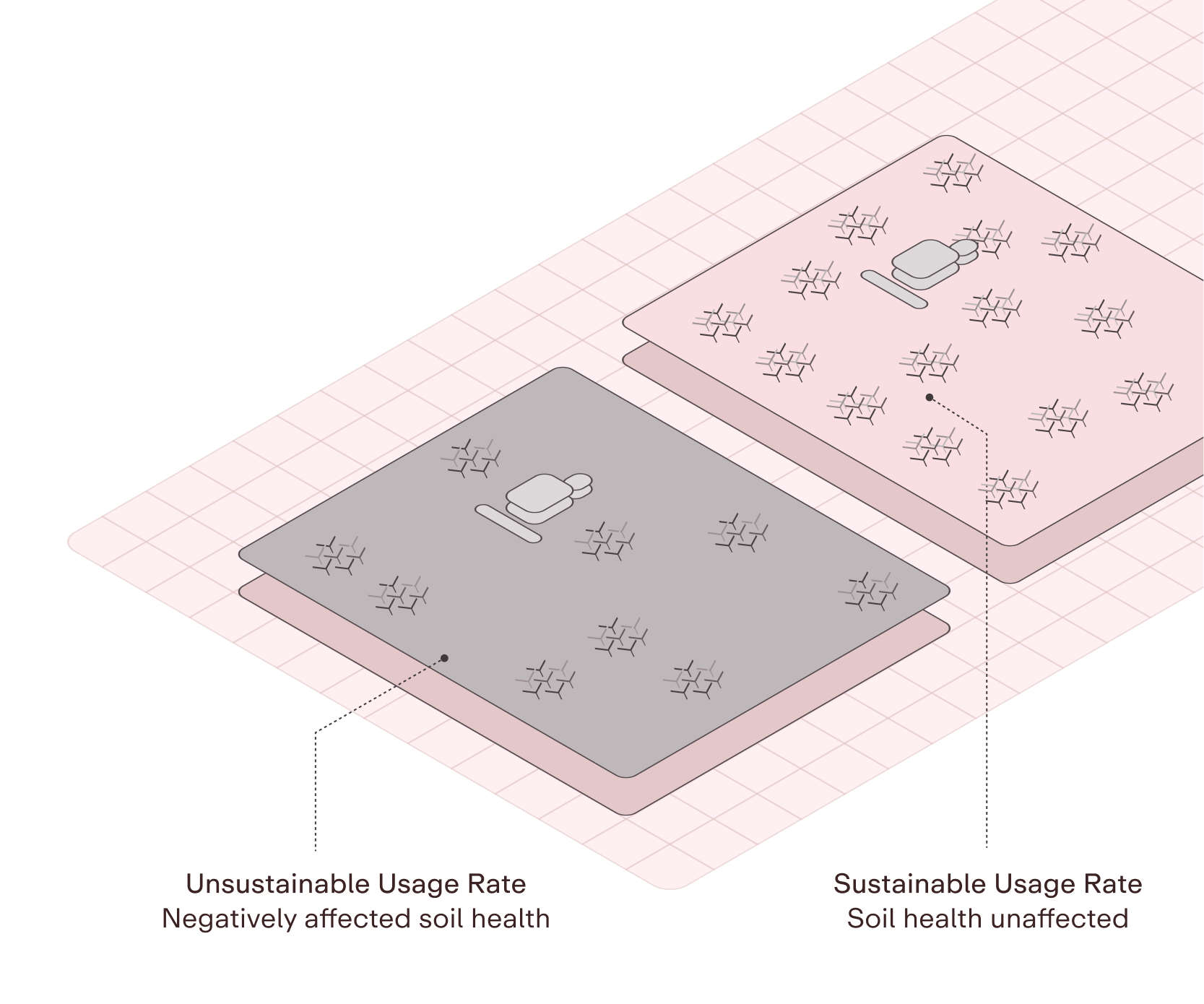
- Sustainable Usage Rate can be used to demonstrate an amount of feedstock over a given time frame that can be sourced with no impact to the upstream service the feedstock supplies. This is typically used to demonstrate an amount of agricultural residue that can be removed from in-field retention without affecting services such as erosion control, nutrient replenishment and water retention. This enables Projects to use a feedstock where no clear excess of supply, such as a stockpile, is evident. For more information see Section 10.6.
10.1
Baseline Feedstock Consumption Rate
The Baseline Feedstock Consumption Rate can be used by Projects that retrofit existing facilities/processes, making use of residues that are generated through the production of primary products. This allows the Project to demonstrate what feedstock would be sourced over a given time frame, regardless of the Project activities, and what feedstock is sourced due to the Project activities. To establish the Baseline Feedstock Consumption Rate Project Proponents must use facility-level data on average feedstock consumption for each feedstock from the 5 years prior to the Project's first procurement date. This is usually calculated from operational data or prior purchase agreements. If such data is unavailable, the value can be calculated using feedstock-to-output ratios. The value will be a rolling average of feedstock consumption over a defined time horizon, typically 5 years for industrial facilities, though other selections may be necessary due to highly variable feedstock consumption or data limitations. The variability of the feedstock consumption must also be characterized for the 5-year baseline period. This can be achieved by calculating the variance of feedstock consumption on both a reporting-period-length and annual level. Normal deviations from the mean versus induced changes can be evaluated using statistical tests such as a statistical process control assessment (SPC) or a similar test with appropriate justification.
If a perceived change in feedstock consumption is detected, the Project Proponent has three options:
- The Project Proponent may justify this variability with evidence that the increase comes from increased demand for their primary products, not facility profitability associated with CDR production. If this increase in demand is determined to be a permanent shift, the baseline can be revised upward as deemed appropriate by a review of the available evidence. If the increase in demand is determined to be transitory in nature, these reporting periods should be omitted from future calculations updating the baseline.
- The Project Proponent may provide sufficient evidence to demonstrate that all biomass sourced in excess of normal baseline operations remains eligible under the Biomass Feedstock Accounting Module.
- The Project Proponent may proportionally credit the fraction of CDR that originates from biomass within their normal operating level, typically defined as three standard deviations above the baseline mean.
Calculated baselines must be representative of historical data, and a seasonal baseline may be appropriate in markets with high-seasonal variability such as energy production facilities.
To utilize the expanded list of criteria options available (e.g., SC2, ML2) by establishing a Baseline Feedstock Consumption Rate, the volume and source of feedstock must be consistent before and after the retrofit.
Should the 5 year baseline period include facility downtime due to exceptional circumstances, these observations will not be included in the average calculation. Baseline periods of shorter or longer durations than 5 years will be considered on a case-by-case basis. Isometric is open to the necessity of some adjustments being made in cases where a facility underwent significant upgrades or efficiency improvements within the baseline period. The adjustments will be made conservatively and justified based on comparisons to other analogous facilities. After the Project start date, the Baseline Feedstock Consumption Rate must be recalculated annually using a rolling average. However, in order to be eligible to revise the baseline upwards, the Project Proponent must demonstrate that the total biomass claimed as falling within baseline operations did not exceed 110% of the Baseline Feedstock Consumption Rate in the prior year In cases where feedstock use by a Project is in excess of the Baseline Feedstock Consumption Rate, the Project Proponent must assess this excess feedstock separately.
10.2
Baseline Emission Rate
For CCS retrofit Projects, Project Proponents may be eligible to use ML2 to quantify market leakage, if their Baseline Emission Rate is greater than the Maximum Biogenic Carbon Utilization Rate of their capture process. The Baseline Emission Rate is the annual mass of biogenic carbon that is released as flue gas from the facility pre-retrofit. Like the Baseline Feedstock Consumption Rate, this value will be based on the average annual value over the 5 years prior to the Project start. Ideally, this is calculated from operational data or prior purchase agreements. If such data is unavailable, the value can be calculated using feedstock-to-output ratios.
10.3
Maximum Biogenic Carbon Utilization Rate
The Maximum Biogenic Carbon Utilisation Rate, termed , is the maximum quantity of input biogenic carbon that can be utilized by the capture process. The following calculation will be used to calculate the :
(Equation 7)
Where:
- - The Maximum Biogenic Carbon Utilization Rate
- - The maximum CDR the retrofit is capable of generating annually.
- - The estimated fraction of input biogenic carbon that is captured by the CDR process.
For example, if a facility has a of 100 gross tonnes of CO2 annually, and a of 0.8, the is 1,250 tonnes of biogenic CO2.
10.4
Parasitic Load
The portion of a facility’s on-site biomass energy output (electric and/or thermal) that is consumed by or diverted to equipment, within the Project system boundary thereby reducing net energy available for other uses. Only the share supplied for biomass combustion within the facility is counted as parasitic load. Projects must quantify this energy and convert it to an equivalent feedstock mass using documented fuel properties and conversion efficiencies.
10.5
Baseline Feedstock Generation Rate
The Baseline Feedstock Generation Rate is the rate at which a feedstock supplier produces or generates feedstock material. For example, it could be the rate of manure production at a dairy, or forest residue generation at a forestry operation. Project Proponents calculate this by using facility, farm, or operation-level data on the average annual feedstock generated prior to the Project start date. This Module does not specify a general time horizon, but highly-capitalized industrial facilities or industries with substantial year-to-year variation in feedstock production will select a longer time horizon than farms or forestry operations.
For animal agriculture residues, the Baseline Feedstock Generation Rate is set at the levels of total output 2 years before the Project Proponent sources a batch of feedstock, as outlined in SC4. The Project Proponent must demonstrate that the total annual amount of feedstock the Project Proponent contracts for the current year will be at or below the Baseline Feedstock Generation Rate. Similar methods to those outlined in the Baseline Feedstock Consumption Rate can be used in evaluating the Baseline Feedstock Generation Rate. By linking eligibility to past production, we ensure that increasing production for the purposes of receiving additional payments would incur losses for at least 2 years. Given the low margins in agricultural production and current costs of capital, this delay period likely makes these decisions economically infeasible.
10.6
Sustainable Usage Rate
Some feedstocks may play important economic or ecological roles even if they are not typically sold in markets. For example, farmers may depend on locally available corn stover or manure for fertilization. The Sustainable Usage Rate refers to the maximum amount of a feedstock that can be removed from a region without compromising the region’s ability to meet a specific economic or ecological need. In the case of manure, for instance, the Sustainable Usage Rate would represent the highest annual quantity that can be exported while still leaving enough for farmers who rely on it to meet their fertilization requirements.
The following calculation is an example of how to calculate the Sustainable Usage Rate for manure when there is no observable counterfactual. Other calculations may be appropriate, particularly for other feedstocks, and must be evidenced when submitting the PDD.
(Equation 8)
Where:
- - The Sustainable Usage Rate of the manure mass in tonnes that can be obtained from a feedstock supplier
- - The average annual manure mass in tonnes generated within 5 miles of the source feedlot.
- - The maximum manure mass in tonnes required to satisfy the limiting nutrient requirements of the primary crop within a 15 mile radius.
(Equation 9)
Where:
- - The average manure mass in tonnes generated by a livestock animal per year.
- - The livestock headcount within 5 miles of the manure source.
(Equation 10)
Where:
- - The total number of cropland acres within a 15 miles radius of the manure source. This can be multiplied by the fraction of farmers that use fertilizer within the country or equivalent. If a Project Proponent can demonstrate that no manure has left the property of the feedstock supplier over the previous 2 years, using a manure management plan or signed affidavit, then the CropArea can be constrained to property operated by the feedstock supplier.
- - The maximum potential annual requirement for manure mass in tonnes to satisfy replenishment of the limiting nutrient of an acre of cropland. This limiting nutrient could be nitrogen, phosphorus or potassium. As nutrient requirements vary across crops, Project Proponents must either compute a acreage-weighted average for the value across all major crops in the region or use the value relevant for the the Primary Crop in the region. The Primary Crop is defined as the crop with the highest average annual devoted acreage within the 15-mile radius circle.
If a Project Proponent can demonstrate that all produced manure can be accounted for using a manure management plan or a signed affidavit from the feedstock supplier, the equation can be simplified to:
(Equation 11)
Where:
- - The annual mass of manure produced by the source feedlot.
- - The mass of manure in tonnes from a supplier that is currently used as a nutrient source.
11.0
Appendix 5: Industry Residues Considered to have a low Market Leakage Risk
The following list is to be used as guidance for which industry residues are considered by Isometric to have a sufficiently low risk of market leakage to be eligible to use the Sustainability Criteria outlined in SC5. This list, while not exhaustive, is aimed to highlight appropriate industry residues that are likely to be deemed eligible within this Module. Additional feedstocks will be considered on a case-by-case basis.
| Table 8 | |
|---|---|
| Residues eligible for SC5 | |
| Industry | Residue Example(s) |
| Landscaping | Lawn trimmings, below-grade wood chips, etc. |
| Primary agricultural processing | Rice husks, oat hulls, etc. |
| Food processing | Waste streams from food manufacturing facilities |
| Beverage processing | Spent grains etc. |
| Textiles | Cotton gin trash, wool lanolin etc. |
12.0
Appendix 6: Counterfactual Storage Example Calculations
12.1
Example 1
A Project Proponent identifies an excess supply of corn stover over the SUR. The corn stover contains 30t of biogenic carbon. The counterfactual fate of the excess stover is combustion in piles and therefore all biogenic carbon would be released as emissions much earlier than 15 years.
Convert the carbon to CO2e
Calculate by applying equation 2
Apply equation 1
12.2
Example 2
A Project Proponent sources excess slash residue from an FSC certified forestry project. The wood contains 30t of biogenic carbon. The decay rate of the wood residue is slow due to recalcitrant components such as lignin. The counterfactual fate of the slash material is piled up and left to decay. 25% of the biogenic carbon remains after 15 years. 5% of the biogenic carbon remains after 50 years. 1% of the emissions from decaying C are released as CH4 in the first 15 years. The 100-year GWP of CH4 is 27.
Convert the carbon to CO2e
Calculate by combining CO2 and CH4 emissions as CO2e
Calculate
Calculate by applying equation 2
Apply equation 1
12.3
Example 3
A Project Proponent sources excess oat shells from a hulling facility. The oat hulls contain 30t of biogenic carbon. The current counterfactual fate of the oat shells is that they are left to decay in large piles. The decay rate of the oat shells is fairly slow given the recalcitrant components such as lignin. 25% of the biogenic carbon remains after 25 years. 1% of the biogenic carbon remains after 50 years. 4% of the emissions from decaying carbon are released as CH4 within the first 15 years. The GWP of CH4 is 27.
Convert the carbon to CO2e
Calculate by combining CO2 and CH4 emissions as CO2e
Calculate
Calculate by applying equation 2
Apply equation 1
Footnotes
-
Such as slash material, defined in 40 CFR 80.1401 as "A residue, including treetops, branches and bark, left on the ground after logging or accumulating as a result of a storm, fire, delimbing or other similar disturbance". ↩
-
Downstream wood processing is defined as wood processing that converts raw wood material into products such as sawn timber, plywood, furniture or other goods. ↩
-
The sourcing region is defined as a region of similar ecological characteristics, such as biodiversity, as defined by relevant regional authorities (Carbon Direct 2025). ↩
-
A primary forest as defined by the UN FAO is a naturally regenerated forest of native tree species, where there are no clearly visible indication of human activities and the ecological processes are not significantly disturbed. For more information visit:
https://openknowledge.fao.org/server/api/core/bitstreams/531a9e1b-596d-4b07-b9fd-3103fb4d0e72/content.
Resources to demonstrate the sourcing region is not a primary forest:- https://www.nature.com/articles/s41597-021-00988-7
- https://www.globalforestwatch.org/map/?map=eyJjZW50ZXIiOnsibGF0Ijo1LjQxODg2NzA4ODYxOTUzMywibG5nIjotNjIuNjU0MTYwMDg2MzYzNjQ2fSwiZGF0YXNldHMiOlt7ImRhdGFzZXQiOiJwcmltYXJ5LWZvcmVzdHMiLCJvcGFjaXR5IjoxLCJ2aXNpYmlsaXR5Ijp0cnVlLCJsYXllcnMiOlsicHJpbWFyeS1mb3Jlc3RzLTIwMDEiXX0seyJkYXRhc2V0IjoicG9saXRpY2FsLWJvdW5kYXJpZXMiLCJsYXllcnMiOlsiZGlzcHV0ZWQtcG9saXRpY2FsLWJvdW5kYXJpZXMiLCJwb2xpdGljYWwtYm91bmRhcmllcyJdLCJvcGFjaXR5IjoxLCJ2aXNpYmlsaXR5Ijp0cnVlfV19&mapMenu=eyJkYXRhc2V0Q2F0ZWdvcnkiOiJsYW5kQ292ZXIifQ%3D%3D
- https://www.researchgate.net/publication/351464479_A_Review_of_Definitions_Data_and_Methods_for_Country-level_Assessment_and_Reporting_of_Primary_Forest
-
Such as MSW, waste water treatment sludge, expired food waste, hospital/commercial waste, biogas from the digestion of waste treatment sludge and municipal woody waste. ↩
-
Recovery, transportation and replacement costs include but are not limited to the following:
- Harvesting costs for the feedstock, such as the removal of corn stover residue from fields or the chipping of forestry residues.
- Transportation costs of the feedstock supplier to provide the feedstock to the Project Proponent.
- Replacement costs of the feedstock supplier necessary to accommodate the diversion of feedstock, such as the use of fertilizer, including the cost to source these fertilizers and the cost of spreading these fertilizers.
-
An economic purpose is one providing market recognized economic value through revenue generation or cost reductions for an operation. This could include the sale of good(s) for economic profit, or the use of the feedstock for an environmental service such as soil nutrient enhancement that would otherwise require a costly intervention. ↩
-
The use of marginal emissions rates would be the most conceptually aligned approach with a consequential emissions accounting framework, however currently available data and methodologies for their calculation are not sufficient to permit confident real-world usage. ↩
Contributors

Chris Pollard

Neil Hacker

Emma Marsland

Sebastian Green, Ph.D.

Michael Shell

Isometric
Biomass Feedstock Accounting © 2025 Isometric HQ Ltd is licensed under CC BY-NC-ND 4.0