


Contents
1.0
Introduction
This Module details the requirements for storage of carbon as biochar in the built environment, including reversal risk and durability. Within this Module, a built material is defined as a product used in the construction of buildings or infrastructure projects, including concrete, cement and asphalt. Durability refers to the stability of CO2 stored as biochar in the built material and the length of time for which CO2 is removed from Earth's atmosphere (> 1,000 years). Within this Module, concrete durability is used to refer to the structural durability of concrete. This Module is intended for use in conjunction with other Isometric Protocols and Modules, and assumes the following:
- The full quantification of the net tonnes of CO2e removed for Crediting follows the Isometric Biochar Production and Storage Protocol.
- All environmental and social safeguards have been followed according to the ESS Section in the Biochar Production and Storage Protocol and this Module.
The stability of carbon within the built environment, and thus its durability, depends on interactions with the surrounding environment and intended use case. Built materials used for the construction of buildings or infrastructure projects may be exposed to variable environmental conditions during their use life. Potential risk factors which may affect the expected durability of built materials include, but are not limited to, interactions with acidic fluids (e.g. acid rain, low-pH groundwater), building fire, abrasion and high-temperature closed-loop recycling of concrete. For the purpose of this Module, built materials are treated as an open system storage mechanism. In comparison, closed systems are isolated from external environmental changes.
Biochar storage in the built environment is a novel CDR approach, so this Module incorporates requirements that may be more stringent than some current relevant regulations or other Protocols related to biochar for CDR. This Module will be reviewed when there is an update to scientific published literature which would affect net CO2e removal quantification, durability claims or the monitoring guidelines outlined in this Module. Future versions of this Module may be altered, particularly regarding requirements for demonstrating durability of biochar, as the stability of carbon in biochar is better demonstrated and documented; quantification of biochar degradation is further improved and refined; and the overall body of knowledge and data regarding all processes, from feedstock supply to conversion and to permanent storage, is significantly increased.
Projects seeking Credits from biochar stored in the built environment will be subject to applicability requirements (Section 2.0), biochar characterisation requirements (Section 6.0) and reversal risk assessment (Section 10.0) to account for unobservable reversals.
2.0
Applicability
R-PFG9-0
This Module is applicable to Projects that store CO2 in the built environment in the form of biochar incorporated into built materials. The following products are applicable under this Module:
- Concrete, in which biochar is incorporated as:
- Asphalt, in which biochar is used as:
- Aggregate
- Modifier
- Other building materials (e.g. concrete bricks, roof tiles and potentially geopolymers or plasters) may be considered under this Module if the Project Proponent can demonstrate sufficient similarity in material life cycles as those presented in Section 10.0. This evidence will be audited by Isometric and the VVB and must be included, with full justification, in the PDD.
Projects seeking Credits under this Module must meet the following criteria:
- R-A4BY-0 Construction materials produced with incorporated biochar must meet the same performance requirements of a conventional product for the intended use case. Any required admixtures or processing steps should be standard industry practice and not result in disproportionately greater resource use or emissions compared to conventional materials.
- R-XS7K-0 Construction materials produced with incorporated biochar do not require additional products or activities related to installation and maintenance as compared to conventional products.
Projects that are explicitly not applicable under this Module include:
- Projects storing CO2 in the built environment in the form of carbonate minerals
- Projects storing CO2 in the built environment in the form of lumber
3.0
Background
3.1
Biochar
Biochar is a durable carbon-rich solid material produced from the pyrolysis of waste biomass. The carbon content in biochar can be further separated into stable (with inertinite as a proxy) and degradable (labile) fractions. These distinct carbon fractions have different carbon durabilities, with the stable fraction of biochar being stored durably for a time horizon of 1,000 years and above8 while the labile fraction can degrade over shorter time horizons in the range of a few years to decades, when used in conventional soil amendment applications9 (see Isometric Biochar Production and Storage Protocol). Different production processes and feedstocks directly impact biochar's quality and stability, as they may result not only in variations in the proportions of labile and fixed (stable) fraction but also changes in biochar structure.
The labile fraction of biochar gradually degrades over time through various pathways, depending on the conditions of its storage environment. In the context of the built environment, these pathways can include:
- Physical (dust loss, particle size reduction due to reuse or material recycling),
- Abiotic degradation - Chemical reactions related to environmental factors including but not limited to: natural mineralization, photodegradation, leaching due to water flows or freeze - thaw cycles10.
When assessing the total carbon removal capacity for each material, the durability of the stored carbon is impacted by both the biochar quality and type of construction material end application. Therefore, the reversal risk is dependent on the material use, exposure to environmental conditions and how these interact with the building elements. See Section 10.0 for further discussion of reversal risk and how this is used to determine an uncertainty discount for biochar in the built environment.
In recent years, the incorporation of biochar in construction materials has been receiving increasing interest, owing to its unique properties such as porosity, high specific surface area, water retention capacity and organic carbon content. Biochar's unique structure and porosity makes it a versatile and innovative material that can be utilized in multiple applications including concrete, asphalt, bricks, tiles, insulation materials11, composites, panels, plasters and geopolymers. These uses not only contribute to permanent carbon removal but may also enhance specific material properties12.
Previous studies have focused on integrating biochar in construction materials as a substitute, filler, additive or modifier, mainly in concrete and asphalt production4,12. Applications that have gained traction include biochar used in:
- Concrete production process as an aggregate replacement12
- Cement production as a filler material, reducing the amount of carbon intensive clinker and concrete
- Asphalt applications used as an asphalt modifier and/or binder13
These applications are discussed in further detail in Section 1.2.2.
3.1.1
Additional Removal Potential
New research on biochar stored in built materials has shown that these novel materials may capture additional CO2 from the air, particularly in the case of biochar - cement composites14. Replacement of the aggregates in concrete production with biochar improves pore size distribution12 and can enhance the CO2 carbonation process and increases concrete's ability to sequester carbon2.
At the time of writing, there is not sufficient evidence to include this in the quantification framework for net CDR achieved by biochar storage in the built environment. This will be revisited in future editions of the Module as new evidence is published and/or presented to Isometric by Project Proponents as proof of quantification.
3.2
Built Environment
3.2.1
Concrete
Concrete, made from cement, sand, aggregate, water, and chemical admixtures, is the most widely used construction material in the world, with approximately 4.2 billion tonnes produced globally in 2020 (Global Cement and Concrete Association, Cement and Concrete Around the World). Compared to other structural materials, concrete has a relatively low cost and embodied carbon, while also providing strength, durability and adaptability. However, because of the large volume of concrete produced and used globally, the concrete supply chain has a large carbon impact - accounting for approximately 5-8% of total global CO2 emissions15. The vast majority of emissions during concrete production result from manufacturing Portland Cement (PC) via calcination. During this process, crushed limestone (CaCO₃) is heated in a kiln to high temperatures (~1400°C), causing degradation to CaO (lime) and CO2:
(Equation 1)
Though a portion of emissions are associated with processing limestone and heating the kilns, approximately half of the process emissions are the result of direct emissions from calcination16.
Using less material in the built environment and using lower embodied carbon alternatives to PC both play a key role in efforts to reduce the climate impact of the construction industry. Several recent studies (summarized well in Legan et al.14) have shown that addition of biochar in building materials, notably cement, can improve several key performance indicators while reducing the environmental impact of concrete production. For example, researchers have observed enhanced mechanical properties of biochar-amended concrete, including compressive, flexural and tensile strength; thermal stability and conductivity; bulk density; ductility; flowability; water absorption and penetration potential; and albedo17. However, some studies have also noted decreased flexural strength17 and decreased compressive strength18 at biochar dosages up to 40% by mass of cement.
Limits to the amount of biochar addition in construction materials are dictated from material specification and performance standards, especially in terms of the fresh and hardened mechanical properties of concrete and other cementitious composites. The impact on the mechanical performance and other properties is dependent on the biochar type (e.g., feedstock used, temperature of production, post-processing), percentage of biochar incorporated, and concrete mix design. Previously reported limit values of biochar in built materials ranged from 0.5% - 40%14, although these thresholds can vary depending on the material and application. Biochar is typically added at rates of up to 20% and 15% in concrete and asphalt production, respectively19,20,21.
Figure 1: Stages of a concrete product, from materials extraction, through processing, use and end-of-life scenarios. Biochar is incorporated in the processing stage as aggregate, filters or as an SCM.
3.2.2
Asphalt
Asphalt is a viscoelastic material that is commonly used in pavement construction, roofing and other building applications18. It is a composite material typically including a mixture of aggregate materials, such as crushed stone, sand and gravel, bound together with bitumen, a highly viscous material derived from petroleum. Asphalt production requires significant energy consumption and is consequently an emissions-intensive process22. Conventional methods of asphalt production are referred to as 'hot-mix asphalt', in which aggregates are heated to remove moisture and are combined with bitumen at high temperatures (typically 170-190°C)23.
Several alternatives to hot-mix asphalt have been proposed to reduce the environmental impact of pavement construction. These include warm-mix asphalt, which produces a similar product at lower temperatures (130-150°C)22; recycled asphalt pavements; and bio-asphalt, which encompasses both the partial replacement of fossil fuel-derived bitumen with plant-derived bio-oil24 and addition of biochar to the mixture as an asphalt modifier21. Recent studies have shown that addition of modest amounts of biochar can maintain the rheological behaviors and enhance the oxidation resistance of asphalt25, improve deformation resistance24, and inhibit volatile organic compounds (VOCs)26.

Figure 2: Stages of an asphalt product, from materials extraction, through processing, use and end-of-life scenarios. Biochar is incorporated in the processing stage as an aggregate.
3.2.3
Built Asset Life Cycles
3.2.3.1
Types of Built Assets and Associated Design Life
Performance requirements for built assets and individual components are influenced by a complex set of factors, including the intended design life, the exposure environment and the mechanical properties needed to meet the requirements of the installation and application.
The design life of a built asset is the assumed period for which it can be used for its intended purpose. Examples of common asset types and design lives (as defined in EN 1990:2023 and CD 226) are summarized in Table 1. Assets with slow rates of change, such as transport or public health infrastructure, will typically be designed with a longer service life and the minimization of maintenance in mind. Corporate office buildings, which are more likely to change in alignment with trends, may be designed with replaceability, adaptability or de-constructability in mind. It is important to note that design life of an asset is not necessarily equivalent to functional service life, which may be longer or shorter than the design life based on a variety of factors such as asset ownership, changes in regional regulatory environments, societal preferences and asset performance. A study of buildings in North America found that the majority of demolished buildings were less than 50 years old27 and the Royal Institute of British Architects highlight that, in the UK, the functional service lives of buildings within the commercial sector are 25 to 30 years28.
Table 1: Overview of common asset types and their design lives as defined in EN 1990:2023 and CD 226.
Asset Type | Design Life (years) |
|---|---|
Monumental building structures, bridges, other civil engineering structure supporting road or railway traffic | 100 |
Building structures, including commercial and residential buildings | 50 |
Asphalt pavement | 40 |
Agricultural (or similar) structures, replaceable structural parts other than tension components | 25 |
Temporary structures (e.g. pavilions, emergency buildings, structures associated with specific sport or art events) | < 10 |
Within a given asset, different components will have different expected design lives. For some element groups, such as the structural skeleton of buildings or the piers of a bridge, which serve the key functional purpose of providing the structure of the asset, the goal is a long service life. Elements with more transient functional requirements, such as internal space partitions, or those prone to disturbance, such as paving over buried services or utilities, will typically have shorter design lives.
Concrete may be used in one or more types of asset throughout its functional life, depending on regional policies and trends surrounding end-state concrete use. This topic is covered in further detail in (Section 3.2.3.2.1). Similarly, asphalt may be recycled into new pavement or other civil engineering projects throughout its functional life (Section 3.2.3.2.2).
Across long timescales, the process of construction, demolition and reuse may occur several times, and each of these cycles will have a Project-specific associated reversal risk (described in depth in Section 10.0). Consequently, the uncertainty in the remaining biochar content, and thus the volume of CO2 stored within a given amount of a built material, increases with each subsequent construction-demolition-reuse cycle. The design life of an asset therefore influences the number of these cycles that an amount of concrete may move through across 1,000+ years, which is critical for informing models of reversal risk (Section 10.0). A list of common asset types and their typical design life (as defined in EN 1990:2023 and CD 226) is given in Table 1.
3.2.3.2
End-State Use Cases
3.2.3.2.1
Concrete
Figure 1 summarizes the typical life cycle of concrete, from procurement of raw material, through to processing, use and end-of-life scenarios. In the context of this Module, end-state use case refers to the fate of a given amount of biochar-amended concrete co-located within a single asset after the functional service life of that asset. How concrete is used after the end of an asset's life is influenced by a variety of complex factors, notably the geographic location and the economic and regulatory landscape for particular waste routes. Here, we discuss five possible end-state use cases and implications for CO2 stored within concrete.
1. In-situ Reuse
In-situ reuse refers to extending the use of concrete in its original form. Some level of repair may be required. Because the concrete remains in its original form, it is not subjected to additional reversal risk and stored biochar is considered stable.
2. Ex-situ Reuse
Ex-situ reuse refers to reuse of concrete in its original form, but in a different asset. This is uncommon practice for reinforced structural concrete elements due to the difficulty of extracting these components, lack of demand and the relatively low cost of new concrete. There are greater opportunities for ex-situ reuse with precast concrete elements, as these may be designed to facilitate deconstruction. There are currently limited regulatory frameworks worldwide that incentivize extensive re-use, though some examples do exist (see Norwegian Standard NS 3682). Frameworks currently under development will likely limit concrete reuse based on exposure class, potentially resulting in more extensive reuse of lower performance elements. Because the concrete remains in its original form, it is not subjected to additional reversal risk and stored biochar is considered stable.
3. Closed-loop Recycling
Closed-loop recycling refers to waste processing that occurs in a closed loop, allowing the waste to retain its original value and return to the original production process. Technologies for concrete closed-loop recycling remain nascent and have not yet been deployed at scale. As such, the current likelihood that concrete will be recycled at end-of-life is very low. However, it is important to note that closed-loop recycling commonly involves high-temperature waste processing that may result in exposure and degradation of stored biochar.
4. Downcycling
Downcycling refers to waste processing where the resultant product has lower value than the original product. This is the most common end-state use case for concrete, for example approximately 90% of concrete and demolition waste in the UK is managed in this way (DEFRA, UK Statistics on Waste29. This process typically involves crushing of concrete and subsequent use in applications such as road subbase, coastal defenses, engineering fill and external landscaping. Downcycled concrete may also be used as aggregate in new concrete products in instances where contamination from other waste products is low. Downcycling increases uncertainty about the location of biochar-amended concrete, but does not introduce any direct reversal risks.
5. Landfill
Concrete is landfilled when it cannot be effectively used in another application through reuse, closed-loop recycling or downcycling. Landfilled concrete can be assumed to remain within a single storage location for long timescales, decreasing geographical uncertainty. However, additional reversal risks may be introduced (e.g. acidic groundwater) depending on regional environmental characteristics and regulations.
3.2.3.2.2
Asphalt
A report published by the National Asphalt Pavement Association in 202430 found that 99% of reclaimed asphalt pavement (RAP) is recycled, with 93% reused in new asphalt pavements and the remaining percentage used in other civil engineering projects, such as unbound aggregate bases. A small percentage (0.2% reported in 2022) of RAP is landfilled if it cannot be used in construction, for example if it contains hazardous materials.
In addition to recycling and landfilling of asphalt, it is important to note that some material is removed from road surfaces due to abrasion caused by friction between tire treads and the pavement, generating tire wear particles (TWP) and road pavement wear particles (RPWP). The road abrasion rate is dependent on several factors, including driving conditions and traffic volume, but has been reported at 0.04-0.5 mm per year 31. A recent study 32 found that, for asphalt pavement, wear particle size distributions peaked at 63-106 μm, with 84% of the wear particles falling in the size range of 38-212 μm. This introduces uncertainty in the environment to which these particles will be exposed and may potentially increase the risk of reversal (See Section 10.0). If biochar is used exclusively in sub-surface layers (e.g., binder or base courses), it is generally not exposed to direct mechanical wear and thus less susceptible to particle loss through abrasion. Project Proponents are recommended to specify the location of biochar within the pavement structure. However, it should be noted that the approach for assessing reversal will still be consistent with the approach used for concrete applications (See Section 10.0).
4.1
Required measurements
As outlined in the Biochar Production and Storage Protocol, there are some potential risks to environmental and human health associated with biochar composition, for example:
- Heavy metals, which may impact soil health and may be transported through groundwater flow
- Contamination Persistent Organic Pollutants
R-52YX-0
Project Proponents must include environmental legal and regulatory requirements applicable to their Project in the PDD. In the absence of regulation, the World Biochar Certificate guidelines must be met for storage of biochar in materials for:
- Heavy metals; including Pb, Cd, Cu, Ni, Hg, Zn, Cr, As, Sb, Co, V (declaration of concentration required)
- Organic contaminants; including:
a. 16 EPA PAH (declaration of concentration required) b. PCB (0.2 mg kg⁻¹ DM) c. PCDD/F (20 ng kg⁻¹)
R-RQTJ-0
Best practice for how to carry out measurements of these parameters is provided by the World Biochar Certificate33, and should be followed by Project Proponents and outlined in full in the PDD.
5.0
System Boundaries
Activities that were already occurring and would continue to occur without the Project may be omitted from the system boundary of the GHG accounting, if evidence that the activity was already occurring and would have continued to occur in the absence of the biochar storage activity can be provided.
R-CCP7-0
Emissions associated with upstream and downstream activities associated with the biochar storage process may be omitted from the system boundary if the biochar-amended product meets the same performance requirements as a conventional product for the intended use case and does not require additional products or activities related to product manufacturing, installation, maintenance and end-of-life, as compared to conventional products.
This is based on the assumption that emissions associated with biochar-amended product manufacturing, installation, maintenance and end-of-life would have occurred anyway had a different product been produced and used. The exception to this rule is that additional information is required for exclusion of transport emissions, including transport of biochar-amended built materials to the end-use site (defined as the final location where the biochar-amended product is installed or used). This is to negate the risk of induced transport associated with lower availability of novel biochar-amended products. In order to exclude transport emissions from the system boundary, the Project Proponent must provide suitable justification that transport distances are expected to be within the bounds of national average transport distances for equivalent conventional materials.
Emissions associated with all activities and equipment related to biochar storage in the built environment must be fully accounted for within the Project system boundary.
6.0
Biochar Characterization
R-6F0N-0
The chemical analyses required to assess the reactivity and durability of biochar-C in different storage environments are given in Table 2. Some of these measurements will be used in the quantification of CO2e stored, as outlined in Section 7.0. The required and recommended measurements listed below investigate multiple mechanisms of reactivity (or prevention of), including aromaticity and aromatic condensation, functional groups and volatility.
Specific analysis, including heavy metals and PAHs, should be conducted to assess the potential impact of biochar when used in building materials.
Please note that this is not an exhaustive list of analytical methods for each property. If Project Proponents wish to use an alternative, appropriate method of analysis, they may justify its use in the PDD.
Table 2: Requirements for physical characterization of biochar
Property | Threshold | Analytical Method | Description | Monitoring Frequency | Recommended or required? |
|---|---|---|---|---|---|
Total Carbon Content | Standard Test Methods for Determination of Carbon, Hydrogen and Nitrogen in Analysis Samples of Coal and Carbon in Analysis Samples of Coal and Coke ASTM D5373 or Standard Test Method for Determination of Carbon, Hydrogen and Nitrogen in Analysis of Solid Biofuels EN ISO 16948:2015 | The carbon content of applied biochar is necessary for the quantification Corg and thus CO2e stored, in accordance with Section 7.0 See the Biochar Production and Storage Protocol for carbon content sampling guidance. | Measure every production/storage batch as per the guidance in the Calculation of Cbiochar section of the Biochar Protocol. Minimum number of 3 samples per storage batch. | Required | |
Inorganic Carbon Content (Cinorg) | Standard Test Method for Rapid Determination of Carbonate Content of Soils ASTM D4373-02 or Testing of Solid Fuels - Determination of the Carbonate Carbon Dioxide Content DIN 51726:2004-06 | Measurement of inorganic carbon in biochar is required to accurately differentiate Corg from total carbon content, which may include both inorganic and organic forms. Only Corg is credited for under this Protocol and Module. | Measure every production/storage batch as per the guidance in the Calculation of Cbiochar section of the Biochar Protocol. Minimum number of 3 samples per storage batch. | Required | |
mbiochar | Direct mass measurement with calibrated weigh scales | The carbon content of applied biochar is necessary for the quantification of CO2e stored, in accordance with Section 7.0. See the Biochar Production and Storage Protocol for carbon content sampling guidance. | Measure every storage batch | Required | |
Moisture Content | Standard Test Methods for Determination of Moisture Content in Analysis Samples of Wood Charcoal ASTM D1762-84 or Standard Test Method for Determination of Moisture Content in Analysis of Chemical and Physical Tests of Soil Improvers BS EN 13040:2007 | The moisture content of applied biochar is necessary for the quantification of CO2e stored, in accordance with the Biochar Production and Storage Protocol. Carbon content can be reported on a dry basis to account for differences in total biochar mass. | Measure every production/storage batch as per the guidance in the Calculation of Cbiochar section of the Biochar Protocol. Minimum number of 3 samples per storage batch | Required | |
Random Reflectance (R₀) | White-light microscopy, eg ISO 7404-5:2009 | Random reflectance is an indicator of aromaticity, aromatic ring unit size and condensation. A R₀ value greater than 2% has been proposed as a benchmark for quantifying the permanent pool of carbon in a biochar. The R₀ frequency distribution histogram can be used to decide what fraction of biochar above this benchmark can be classified as chemically inert 8. | Measure every production/storage batch as per the guidance in the Calculation of Cbiochar section of the Biochar Protocol. Minimum number of 3 samples per storage batch | Required | |
Reactive Organic Carbon and Residual Organic Carbon (Cnon-reactive) | Thermogravimetric analysis e.g., Hawk, Rock-Eval® or equivalent. The sample is subjected to re-pyrolysis using a standardized heating procedure: it is first held isothermally at 300 °C, then heated at a rate of 25 °C per minute until reaching 650 °C. During this stage, the reactive organic carbon is volatilized and quantified. The remaining material, referred to as “residual organic carbon,” is subsequently measured by combustion at temperatures up to 850 °C. | Measurement of reactive organic carbon in biochar is important because this fraction represents the more labile, easily degradable component of organic carbon. Elevated levels of ROC can reduce biochar’s long-term carbon stability, as it is more susceptible to microbial decomposition and mineralization in soil. Random reflectance values are subsequently only applied to the residual, stable fraction of biochar. | Measure every production/storage batch as per the guidance in the Calculation of Cbiochar section of the Biochar Protocol. Minimum number of 3 samples per storage batch | Required | |
Ash Content | Standard Test Method for the Determination of Ash Content in Solid Biofuels ISO 18122:2022 | Ash is the inorganic portion of biochar that will not volatilize even if combusted | Measure every production/storage batch as per the guidance in the Calculation of Cbiochar section of the Biochar Protocol. Minimum number of 1 samples per storage batch | Required | |
Polycyclic Aromatic Hydrocarbons PAHs, sum of USEPA 16 | Gas Chromatography coupled with Mass Spectrometry (GC-MS) and/or High Performance Liquid Chromatography analysis eg ISO 13859:2014 or BS EN 17503:2022 | Polycyclic aromatic hydrocarbons are organic molecules with fused aromatic rings that can be formed during the pyrolysis process and retained in the biochar. They are chemically stable with a high sorption capacity, known carcinogens and are persistent pollutants that can travel in the environment chain. | Measure at project validation unless feedstock, reactor or process parameters change. Minimum number of 1 sample | Required | |
Heavy metals including As, Cr, Cd, Co, Cu, Hg, Ni, Pb, Sb, Zn, V | Elements As, Cd, Cr, Cu, Ni, Pb, Zn refer to EN ISO 17294-2 ICP - MS standard test method for determination of selected elements. Element Hg refer to ISO 16772:2004 standard test method for the determination of Mercury using cold - vapor atomic absorption spectrometry. Elements Sb, Co, V refer to EN 15411:2011 standard test method for the determination of trace elements | Concentration of heavy metals in biochar is dependent on the feedstock and the process used35. Specific heavy metals have adverse effects and are selected for monitoring36. High concentrations of heavy metals may result in bioaccumulation in biotic systems and increase toxicity in soils and the environment37. | Measure at project validation unless feedstock, reactor or process parameters change. Minimum number of 1 sample | Required |
7.0
Quantification of CO2eStored
7.1
Summary
This section details the calculation of net CO2 storage in biochar-amended built materials. The monitoring requirements are described in detail in Section 8.0.
Accurate quantification of net CO2 stored requires a robust quantification of associated project emissions within the project boundary. In the context of this Module, a Project refers to the point of CO2 capture and the point of CO2 storage. This Module defines the point of CO2 storage as the point of incorporation of biochar into a built material. Note that this Module only applies to biochar that is considered to be durable for 1,000 years.
R-KPDH-0
Projects are required to provide detailed descriptions of project boundaries for all Crediting activities. Project boundaries must include all areas where removal mechanisms/processes may occur, removed carbon storage locations/forms and potential reversal/loss pathways.
7.2
Quantification of CO2eRemoval
The quantity of net CO2 removal for each Reporting Period,RP, can be calculated as follows:
(Equation 2)
Where:
- is the net quantity of CO2e removed as a result of Project activities during a Reporting Period, in tonnes of CO2e.
- is the total quantity of carbon stored as biochar in the built environment during a Reporting Period, in tonnes of CO2e.
- is the total quantity of CO2 removed from the atmosphere and permanently stored in the baseline scenario during a Reporting Period, in tonnes of CO2e.
- is the total quantity of greenhouse gas (GHG) emissions from Project activities for a Reporting Period, in tonnes of CO2e.
7.2.1
Calculation of CO2eStored
(Equation 3)
Where
- is the total quantity of carbon stored as biochar in the built environment during a Reporting Period, in tonnes of CO2e.
- is the carbon content of the biochar (empirical, in %).
- is the dry mass of biochar incorporated, in tonnes.
- is the fraction of durable biochar that remains in the built material for the full duration of the Crediting timeline (1,000 years), and can be Credited under this Module.
- is the mass fraction of carbon dioxide and elemental carbon.
7.2.1.1
Calculation of Organic Carbon Content
This Module only Credits for the durably stored organic carbon fraction of biochar, which is used to calculate . While biochar associated inorganic carbon generally makes up a small fraction of total biochar carbon. However, the fate of biochar-associated inorganic carbon is much less predictable. Thus, is calculated using the following equation:
(Equation 4)
Where:
- Total Carbon Content is the total carbon content of the biochar as analysed using the methods described in Table 2.
- is the inorganic carbon content of the biochar as analysed using the methods described in Table 2, in %.
7.2.1.2
Measurement of Mass of Biochar Incorporated
See the relevant section of the Biochar Protocol for full guidelines on measurement of mass of biochar buried, .
7.2.1.3
Calculation of FDurable, Material
is calculated as:
(Equation 5)
Where:
- is the fraction of durable biochar that remains in the built material for the full duration of the Crediting timeline (1,000 years), and can be Credited under this Module.
- is the fraction of biochar that is present as inertinite.
- is the fraction of biochar that is assumed to degrade over a 1,000 year period. Note that a safety factor of 3 is included in this calculation to account for uncertainty in the amount of exposure over a 1,000 year period.
- is the fraction of biochar that is not present as inertinite and may degrade if exposed to ambient atmospheric conditions.
7.2.1.3.1
Calculation of
The quantification framework for determining the for 1000-year durability is based on the quantification approach set out by Sanei et al,. (2024)8 11 This approach quantifies biochar on the random reflectance value of the biochar, compared to inertinite as a proxy for geologically stable carbon. Using petrographic analysis, Sanei et al., (2024)8 identified that biochars with a mean random reflectance (R₀ ≥ 2%) exhibit structural characteristics equivalent to inertinite macerals in fossil coals and chars, which are known to persist over geological timescales.
R-7B96-0
As outlined in Section 6.0 of this Module, Project Proponents must report a set of at least 500 measurements of , calculated at the maceral-level, for each sample of their biochar. Batches that adopt this measurement approach can be credited for the fraction of their biochar which passes the 2% benchmark, as outlined in Sanei et al. (2024)8. The histogram of the values must be submitted at the point of project verification for this Crediting option. This method was further updated in Sanei et al., (in submission)38 to refine the methodology to only account for the recalcitrant fraction of biochar (discounting the reactive fraction, determined by thermogravimetric analysis).
To ensure a conservative approach when Crediting biochar durability, we account for uncertainty in both measurement, and the proportion of carbon that is non-reactive. Specifically, the credited durable fraction () is calculated using the mean values for each parameter reduced by one standard deviation. This method ensures that the durability estimate reflects a lower-bound confidence level, mitigating the risk of overestimating long-term carbon storage.
As such, is calculated as:
(Equation 6)
Where:
- is the fraction of inert carboniferous material in a sample after 1000 years.
- is the mean of R₀ measurements, in %.
- is the individual measurements of , in %.
- is the number of measurements for .
- is the mean of measurements, in %.
- is the individual measurements of , in %.
- is the number of measurements for .
Quantification of biochar storage for Crediting in the built environment will be updated in future versions of this Module in line with the best available science as more research in peer-reviewed literature is published.
7.2.1.3.2
Calculation of
This Module distinguishes between for biochar stored in concrete and biochar stored in asphalt. Note that for biochar stored in asphalt is assumed to be 100%, and thus the labile fraction is not included in calculation of .
in concrete is determined through a geochemical model that assesses the weathering of a given built material over 1,000 years. An overview of the geochemical model used for this assessment and key assumptions underlying this model are given in Section 10.0.
The default value, based on a worst-case assessment (described in Section 10.0), is 2%. Project Proponents may choose to submit additional documentation to conduct a project-specific reversal assessment. As shown in Equation 5, a safety factor of 3 is applied to to ensure a conservative estimate. This approach, and the safety factor applied, will be reassessed as scientific consensus evolves.
7.2.1.3.3
Calculation of
is defined as the portion of biochar that is not considered inertinite (e.g. does not pass the 2% threshold). It is calculated as:
(Equation 7)
Where:
- is the fraction of biochar that is not present as inertinite and may degrade if exposed to ambient atmospheric conditions.
- is the total mass of biochar mixed into the concrete.
- is the total mass of the inertinite fraction of the biochar mixed into concrete.
7.2.2
Calculation of CO2eCounterfactual,RP
For biochar production, the calculation of is determined by the requirements laid out in the Counterfactuals section of the Biomass Feedstock Accounting Module.
7.2.3
Calculation of CO2eEmissions,RP
is the total greenhouse gas emissions associated with a given Reporting Period, RP.
Equations and emissions calculation requirements for including emissions associated with reactor operations and reaction monitoring, are set out in the relevant Protocol and are not included in this Module. Specific considerations for CO2 stored as biochar in built materials are set out here.
CO2 removals must not be double counted, regardless of the production of product Environmental Product Declarations. The product must still comply with all relevant emission accounting regulations and requirements, which may mean emissions are double counted, however removals must not be double counted. This is the most conservative approach to take. Crediting claims must be transparently reported and must not form part of marketing for a separate product.
Allocation procedures may be undertaken to separate emissions associated with the concrete production and the emissions associated with the CO2 storage process. Allocation procedures must follow the following emissions allocation procedure:
- Procedure 1: Allocate all emissions to CDR
Projects may opt to allocate all emissions to CDR. - Procedure 2: Divide the process into sub-processes
Where possible, the process may be divided into sub-processes. For example it may be possible to isolate processes relating to processing and storing CO2 only. Only sub-processes and relevant inputs that are physically separable may undergo division, for example electricity usage for equipment with separate electricity meters. Sub-processes that are physically separable and do not contribute to CDR may be excluded from the CDR system boundary.
Transport emissions must be considered if the average transport distance for biochar-amended built materials is more than the average transport distance of normal products produced by the production facility. All other downstream emissions may be excluded from the system boundary if these activities were already occurring and would continue to occur in the absence of the Project. This can be evidenced by providing documentation that biochar-amended product meets the same performance requirements of a conventional product for the intended use case, as is described under 'Applicability'.
7.3
Buffer Pool
As outlined in the Risk of Reversal section of the Isometric Standard, the Buffer Pool is a mechanism used to insure against Reversal risks that may be observable and attributable to a particular project through monitoring. Based on present understanding, reversals in Biochar storage will not be directly observable with measurements and attributable to a particular project. Projects Crediting against this Module are Credited conservatively to account for degradation of labile pools of biochar within the relevant Crediting time horizon. Projects applicable to this Module are categorized as having a Very Low Risk Level of Reversal according to the Isometric Standard Risk Assessment Questionnaire. The Buffer Pool corresponding to this lowest risk score is 2% and is intended as an additional precaution against unknowns.
8.0
Monitoring Requirements
This section outlines the monitoring requirements for Projects incorporating biochar in building materials either as a filler, aggregate, modifier or other form.
8.1
Process Requirements
R-V04V-0
Project Proponents are required to provide detailed information on the end material production process in the PDD. This must include:
- The reactor and equipment description including engineering design diagrams.
- Mass percentage of biochar wt.% incorporated into the final construction material (e.g., concrete, brick, insulation panel).
- Process specific details including energy consumption, curing steps or processing temperatures.
- A list of all additional materials or admixtures (e.g., superplasticizers, accelerators, binders) that are required as a direct consequence of using biochar, along with an explanation of their function and whether they would be present in the baseline mix design.
R-EN0G-0
To verify incorporation of biochar into the final product, Project Proponents must provide documentation in the PDD in one of the three forms:
- Bills of sale for biochar-containing admixtures or materials.
- Final product specifications from downstream users, or
- Environmental Product Declarations (EPDs) where available.
If the biochar-based product is sold to multiple downstream manufacturers (e.g., concrete producers with different mix designs), Project Proponents may provide a representative range of use cases and typical incorporation rates, along with supporting documentation. In such cases, justification for the assumed biochar content in the final construction material must be clearly stated, and conservative assumptions must be used.
8.1.1
Reactor and Equipment Description
R-29W5-0
An engineering design diagram of the process steps and equipment used must be included in the PDD. The design diagram must include:
- Details of the processing steps.
- Dimensions and footprints of the equipment and/or reactor.
- The location of materials inflows/outflows.
- Positioning of sensors and any monitoring devices (e.g., flow meters, temperature sensors).
Process details should include acceptable processes including, but not limited to:
- Particle size reduction grinding or milling.
- Mixing, stirring or blending.
- Calcination.
- Drying and heating (mainly applicable for asphalt production).
8.1.2
Biochar Characterization
R-NYQT-0
Characterization of biochar and ongoing monitoring requirements are outlined in Section 6.0 and must be included in the PDD for validation and subsequently submitted for verification adhering to the sampling frequency requirements.
8.1.3
Storage Site
Though not required, providing specific site information can help demonstrate reduced risk of carbon loss if certain thresholds are met and highlight portions of the material stream that may require additional assessment. This may include:
For asphalt applications:
- Asphalt lifespan
- Traffic density
- Asphalt density
For concrete applications:
- Structural/design lifespan of concrete
- Exposure class (e.g. using EN206 or equivalent)
- Concrete type and strength class
- Application type (example include but are not limited to; foundations, structural, decorative)
- Demolition likelihood or planned obsolescence
- Estimated fraction of returned or unused concrete from construction sites, and its associated end-of-life fate (e.g., landfill, reuse, downcycling)
9.0
Compliance with Product Standards
G-MB8N-0
An applicability criteria for Crediting with this Module is that the biochar-amended built materials must meet the same performance requirements as conventional products for the intended use case. Project Proponents are required to demonstrate compliance with the relevant standards for the use case of each mix produced, while also demonstrating the product is comparable to traditional products and results in no additional product use. It is the responsibility of the Project Proponent to clearly demonstrate comparability between produced products and traditional products within the PDD submitted to the Project VVB and Isometric. Standards, methodologies and SOP's that are utilized by a Project Proponent must be clearly outlined and referenced in the PDD upon submission, and deviations from standards must be highlighted.
R-9KKF-0
Built materials produced for the purpose of carbon storage and Credit issuance are expected to meet the required performance standards and criteria for the intended application, as defined by applicable codes or regulations. These materials should be demonstrably fit for purpose and comparable in functional performance to traditional products that would have been used in the absence of the biochar-amended material. This may be achieved through the undertaking of standardized performance testing procedures required in the location the material is utilized. In the absence of local or regional standards related to production and performance criteria, a Project Proponent is required to adhere to International Organization for Standardization (ISO) and/or CEN (the European Committee for Standardization) criteria. The final product should be compliant with relevant product standards such as EN 15804 for Environmental Product Declaration in the construction industry, relevant product classes and quality standards that are applicable.
Evidence and data, resulting from research studies of biochar addition in built materials such as asphalt, cement or other building elements, have shown the potential for additional benefits and improvements on the final product quality 4,39,40. Biochar addition can impact a range of different properties (mechanical, chemical and physical properties) including but not limited to the following:
- Flexural strength (N/mm²)
- Sound absorption (Hz) (applicable for concrete and other building elements like insulation or plaster)
- Compressive strength (N/mm²)
- Tensile strength (N/mm²)
- Density (kg/m³)
- Electrical resistance [Ω]
- Sorption capacity
- Fire resistance (fire retardant or fire resistance)
Project Proponents should include any additional product characterization, analysis and reported properties of the final produced materials. Changes or deviations from the baseline product values should also be included and relevant product standards referenced in the PDD Appendix.
Departures from standard may be permissible on a case-by-case basis. Project Proponents seeking a departure from standard must submit documentation on the requested departure and proof of approval by the relevant regulatory body to Isometric and the VVB.
10.0
Contributors
- Konstantina Stamouli, Ph.D.
- Ella Holme, Ph.D.
- Xueya Lu, Ph.D.
- Rob Brown, Ph.D.
11.0
Definitions and Acronyms
- ActivityThe steps of a Project Proponent’s Removal or Reduction process that result in carbon fluxes. The carbon flux associated with an activity is a component of the Project Proponent’s Protocol.
- AssetAny tangible or intangible property that has value and can be owned, controlled or utilized by an individual or organization. In the context of this module, an asset refers to a physical structure.
- BaselineA set of data describing pre-intervention or control conditions to be used as a reference scenario for comparison.
- Bio-oilA mixture of water, organic acids, aldehydes, ketones, sugars, phenols, and other organic compounds derived from the thermal breakdown of biomass. Thermal breakdown of biomass is achieved via thermochemical processes, such as pyrolysis, which heat biomass in low- or no-oxygen environments to high temperatures (~e.g. 350-650°C). Bio-oil is often also referred to as pyrolysis oil or bio-crude.
- Buffer PoolA common and recognized insurance mechanism among Registries allowing Certificates to be set aside (in this case by Isometric) to compensate for Reversals which may occur in the future.
- Built MaterialA material used in the construction of an asset.
- Carbon Dioxide Equivalent Emissions (CO₂e)The amount of CO₂ emissions that would cause the same integrated radiative forcing or temperature change, over a given time horizon, as an emitted amount of GHG or a mixture of GHGs. One common metric of CO₂e is the 100-year Global Warming Potential.
- Carbon Dioxide Removal (CDR)Activities that remove carbon dioxide (CO₂) from the atmosphere and store it in products or geological, terrestrial, and oceanic Reservoirs. CDR includes the enhancement of biological or geochemical sinks and direct air capture (DAC) and storage, but excludes natural CO₂ uptake not directly caused by human intervention.
- CementA chemical substance used for construction that sets, hardens, and adheres to other materials to bind them together. Ordinary Portland Cement (PC) is the most common cement used in modern concrete. Other types of cement include Ground Granulated Blast-furnace Slag (GGBS), Pulverised Fly Ash (PFA) and natural pozzolans.
- ConcreteA composite material composed of aggregate, cement, sand and water that cures to a solid over time.
- ConservativePurposefully erring on the side of caution under conditions of Uncertainty by choosing input parameter values that will result in a lower net CO₂ Removal or GHG Reduction than if using the median input values. This is done to increase the likelihood that a given Removal or Reduction calculation is an underestimation rather than an overestimation.
- CreditA publicly visible uniquely identifiable Credit Certificate Issued by a Registry that gives the owner of the Credit the right to account for one net metric tonne of Verified CO₂e Removal or Reduction. In the case of this Standard, the net tonne of CO₂e Removal or Reduction comes from a Project Validated against a Certified Protocol.
- Direct EmissionsEmissions that are produced by a specific CDR process and are directly controllable.
- DurabilityThe amount of time carbon removed from the atmosphere by an intervention – for example, a CDR project – is expected to reside in a given Reservoir, taking into account both physical risks and socioeconomic constructs (such as contracts) to protect the Reservoir in question.
- EmissionsThe term used to describe greenhouse gas emissions to the atmosphere as a result of Project activities.
- Environmental Product DeclarationA public document that transparently reports objective, comparable and third-party verified data about products and services' environmental performances from a lifecycle perspective. The EPD is supported by an underlying Life Cycle Assessment (LCA) report, a systematic and comprehensive summary of the LCA project to support the third-party verifier when verifying the EPD.
- Environmental Protection Agency (EPA)A United States Government agency that protects human health and the environment.
- FeedstockRaw material which is used for CO₂ Removal or GHG Reduction.
- Greenhouse Gas (GHG)Those gaseous constituents of the atmosphere, both natural and anthropogenic (human-caused), that absorb and emit radiation at specific wavelengths within the spectrum of terrestrial radiation emitted by the Earth’s surface, by the atmosphere itself, and by clouds. This property causes the greenhouse effect, whereby heat is trapped in Earth’s atmosphere (CDR Primer, 2022).
- International Standards Organization (ISO)A worldwide federation (NGO) of national standards bodies from more than 160 countries, one from each member country.
- Issuance (of a Certificate)Certificates are issued to the Certificate Account of a Project Proponent with whom Isometric has a Validated Protocol after an Order for Verification and Certificate Issuance services from a Buyer and once a Verified Removal or Reduction has taken place.
- Lossesfor open systems, biogeochemical and/or physical interactions which occur during the removal process that decrease the CO₂ removal .
- ModelA calculation, series of calculations or simulations that use input variables in order to generate values for variables of interest that are not directly measured.
- ModuleIndependent components of Isometric Certified Protocols which are transferable between and applicable to different Protocols.
- PathwayA collection of Removal or Reduction processes that have mechanisms in common.
- ProjectAn activity or process or group of activities or processes that alter the condition of a Baseline and leads to Removals or Reductions.
- Project Design DocumentThe document, written by a Project Proponent, which records key characteristics of a Project and which forms the basis for Project Validation and evaluation in accordance with the relevant Certified Protocol. (Also known as “PDD”).
- Project Design Document (PDD)The document that clearly outlines how a Project will generate rigorously quantifiable Additional high-quality Removals or Reductions.
- Project ProponentThe organization that develops and/or has overall legal ownership or control of a Removal or Reduction Project.
- Project boundaryThe defined temporal and geographical boundary of a Project.
- ProtocolA document that describes how to quantitatively assess the net amount of CO₂ removed by a process. To Isometric, a Protocol is specific to a Project Proponent's process and comprised of Modules representing the Carbon Fluxes involved in the CDR process. A Protocol measures the full carbon impact of a process against the Baseline of it not occurring.
- ProxyA measurement which correlates with but is not a direct measurement of the variable of interest.
- RPReporting Period
- RemovalThe term used to represent the CO₂ taken out of the atmosphere as a result of a CDR process.
- ReversalThe escape of CO₂ to the atmosphere after it has been stored, and after a Certificate has been Issued. A Reversal is classified as avoidable if a Project Proponent has influence or control over it and it likely could have been averted through application of reasonable risk mitigation measures. Any other Reversals will be classified as unavoidable.
- Safety FactorA conservative adjustment applied to estimated greenhouse gas (GHG) emission reductions or carbon removals to account for uncertainties, risks, or variability in measurement, permanence, or effectiveness of the credited activity. It reduces the amount of carbon Certificates issued to ensure environmental integrity and avoid over-crediting.
- Sensitivity AnalysisAn analysis of how much different components in a Model contribute to the overall Uncertainty.
- StakeholderAny person or entity who can potentially affect or be affected by Isometric or an individual Project activity.
- StorageDescribes the addition of carbon dioxide removed from the atmosphere to a reservoir, which serves as its ultimate destination. This is also referred to as “sequestration”.
- System BoundaryGHG sources, sinks and reservoirs (SSRs) associated with the project boundary and included in the GHG Statement.
- TICTotal Inorganic Carbon.
- UncertaintyA lack of knowledge of the exact amount of CO₂ removed by a particular process, Uncertainty may be quantified using probability distributions, confidence intervals, or variance estimates.
- ValidationA systematic and independent process for evaluating the reasonableness of the assumptions, limitations and methods that support a Project and assessing whether the Project conforms to the criteria set forth in the Isometric Standard and the Protocol by which the Project is governed. Validation must be completed by an Isometric approved third-party (VVB).
- Validation and Verification Bodies (VVBs)Third-party auditing organizations that are experts in their sector and used to determine if a project conforms to the rules, regulations, and standards set out by a governing body. A VVB must be approved by Isometric prior to conducting validation and verification.
- VerificationA process for evaluating and confirming the net Removals and Reductions for a Project, using data and information collected from the Project and assessing conformity with the criteria set forth in the Isometric Standard and the Protocol by which it is governed. Verification must be completed by an Isometric approved third-party (VVB).
- Waste productAn output of a process that has no intended value to the producer.
12.0
Appendix A: Reversal risk
12.1
Biochar Durability in the Built Environment
12.1.1
Definition of Storage Uncertainty
A key consideration for the durability of CO2 stored in the built environment is not only exposure to conditions in which biochar durability is likely to be negatively impacted, but also the uncertainty in the location of the product at any given time. As described in the relevant section of the CO2 Storage via Carbonation in the Built Environment Module, a built material may go through many different use cases in its life cycle, depending on the initial use case, local regulatory requirements and economic incentives. In the traditional construction industry, there has not been a need to track built materials past the life cycle of an asset, particularly where elements are designed to perform with minimal maintenance or intervention. Thus, biochar-amended built materials are likely to transition through several construction-demolition-reuse cycles with minimal ability to track these changes. Over long time periods (e.g. 1,000 years), this leads to a high degree of uncertainty in both the storage location of the product and, consequently, whether or not the product is exposed to conditions that lead to degradation of the biochar. This necessitates a conservative approach to reversal risk, described in the following section.
12.1.2
Biochar Reversal
The labile fraction of biochar is subject to degradation over a longer period of time due to different degradation pathways that are applicable to the physical storage location. These pathways can include:
- Physical loss - abrasion or erosion of the material surface, or delamination or spalling, fire or high temperature events.
- Abiotic degradation - chemical reactions related to environmental factors including but not limited to: natural mineralization, photodegradation, leaching due to water flows or freeze - thaw cycles, acid rain, reaction with aggressive chemicals41.
- Microbial degradation - through the actions of aerobic or anaerobic microorganisms or lichen colonisation 42,43,44.
Each of these pathways is directly influenced by the storage environment, with the relevant site characteristics influencing which degradation pathways may be most prevalent in that storage environment. The durability of biochar is dependent not only on the storage site conditions but on biochar's physical and chemical properties (see Section 6.0 for more information).
12.1.2.1
Biochar in Concrete
Quantifying the risk of reversal associated with biochar-amended concrete is inherently complex, given the high degree of uncertainty and variability in possible end-states of the concrete over 1,000 years. Degradation of the labile fraction of biochar within concrete can occur when biochar particles become exposed, which may occur when the concrete is in a 'use case' (e.g. as part of a building), or when the concrete goes through an end-of-life transition (e.g. recycled). This is the result of processes such as concrete loss by physical or chemical weathering, demolition of a built asset or other processes that expose additional surface area of the concrete. In most scenarios, physical loss of concrete is likely to be the most prevalent loss pathway, leading to exposure of embedded biochar. This may occur under the following scenarios:
During use:
- Exposure to acid rain
- Contact with acidic groundwater or soils (most relevant for foundation uses)
- Exposure to high temperatures, such as those from house or forest fires
During end-of-life processes:
- Demolition or detonation, which breaks apart concrete and exposes internal material
- Exposure to high temperatures during closed-loop recycling, where concrete is reprocessed into clinker
- Contact with acidic groundwater or leachate in landfill
Note that the likelihood of closed-loop recycling occurring, while potentially resulting in some degradation of the labile fraction of biochar, is currently extremely low due to the nascency of the technology. At the time of drafting, there are a limited number of pilot projects operating at small scale, including in the United Kingdom, France and Canada. As closed-loop recycling is not currently operating at scale, it has been excluded from the calculation of reversal risk at this time. However, it is important to note that closed-loop recycling, if included in the reversal risk model, has a significant impact on the total reversal risk (Figure A1). The inclusion of closed loop recycling in the reversal risk model will be revisited regularly as data availability increases and technologies develop.
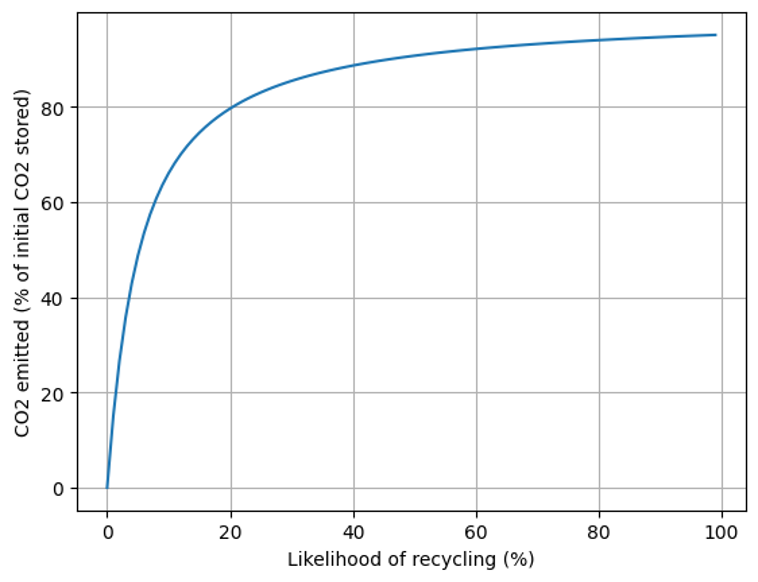
Figure A1: Sensitivity of the likelihood of closed-loop recycling on the amount of CO2 emitted to the atmosphere from closed-loop recycling over 1,000 years. The likelihood of closed-loop recycling was varied from 0 to 100%, while the likelihood of downcycling was decreased accordingly.
12.1.2.2
Biochar in Asphalt
As discussed in Section 3.2.3.2.2 asphalt is abraded over time due to friction between tire treads and the pavement surface. Abraded particles fall within a dust-sized particle size distribution, and thus these particles can be easily transported away from the road surface by wind or water. This leads to uncertainty in the final location of the abraded particles, as well as the interactions between the environment and co-abraded biochar. Equally, exposure to chemicals such as chlorides (from road salt) and sulphates (from surface water) may lead to destabilisation of the biochar structure and increased reactivity. Conservatively constraining the amount of biochar that is abraded and subject to degradation is a critical step in reliably determining the amount of carbon that is durably stored in biochar-amended asphalt.
12.2
Reversal Risk Approach and Calculation of Uncertainty Discounts
12.2.1
Concrete
Due to limited data on the incidence of high-temperature structure fires, the reversal risk presented in this section focuses on reversal through contact with low-pH fluids. Numerical Modelling was adopted as a method for evaluating the associated reversal risks. The model will be revisited as more data becomes available.
To refine the assumption of reversal due to acidic exposure, a geochemical model that simulates CO2 loss from concrete due to long-term acid exposure was developed using PHREEQC (version 3), an open-source program for simulating chemical reactions and transport processes. This model quantifies the extent of degradation in biochar-based concrete over a 1,000-year period due to dissolution of concrete in acidic environments, both naturally occurring (e.g., acid rain, acidic groundwater) and industrially impacted (e.g., acid mine drainage)—across a pH range from 7 to 0.1, and subsequent exposure of the labile biochar fraction to atmospheric conditions.
The geochemical model incorporates equilibrium and kinetic interactions between aqueous solutions and cement phases using the Cemdata18 database: a chemical thermodynamic database for hydrated Portland cement and alkali-activated materials. Key model parameters, data input are sourced from literature studies include: cement composition44,45, reactive surface area (grain size)46,47, reaction constant of specific mineral phases48,49,50,51 and acid concentration52,53.
The geochemical model assumes no carbonation happened within concrete in advance. The Total Inorganic Carbon (TIC) content before acid weathering is recorded and used as baseline comparison with remaining TIC after interaction with various acidic fluids. This model considers acid rain, acidic groundwater, acid mine drainage, and an extreme pH scenario, represented by varying the amount of sulfuric acid in the model conditions. Sensitivity analysis was performed on scenarios where reactive surface area and temperature varied from low to high. The remaining TIC reported for different scenarios is based on consumption of the initial material, with the reaction reaching equilibrium at the last step of the model. This allows for the computation and comparison of the worst case scenario (pH 0.1, high reactive surface area, room temperature). This scenario resulted in approximately 2% loss of the initial concrete material. In some less aggressive conditions (e.g., groundwater at pH 7), the loss was as low as less than 0.001%.
Taking the result of this reversal risk model, some simplifying assumptions can be used to conservatively estimate the portion of biochar that will degrade over 1000 years. These assumptions include:
- Biochar is evenly distributed in the concrete, and the labile fraction is evenly distributed among the biochar particles.
- The labile fraction of exposed biochar will degrade.
Using this framework, it can be assumed that 2% of concrete loss by mass over 1000 years correlates with 2% of biochar by mass that will be exposed to conditions that may lead to degradation of the labile fraction. Thus, to account for this uncertainty, the percentage of the labile fraction that is associated with the 2% of the exposed biochar surfaces will be discounted from . This is also given a safety factor of 3, as described in Section 7.2.1.3, to account for concrete degradation pathways that are not considered within the geochemical model but may result in biochar exposure, such as crushing during demolition.
Note that Projects may choose to provide documentation specific to the region of operations to calculate a Project-specific reversal risk. This documentation may include, but is not limited to:
- Geologic maps of bedrock lithology (from USGS or national equivalent) and groundwater pH.
- Climatic data, including average yearly temperature, precipitation volume and precipitation pH.
- Estimated transport radius of produced materials
- If this is unknown for a given Project, Project Proponents may use either the maximum possible transport distance or a conservative average distance.
- Types of assets that materials may be used in and a breakdown by percentage.
- Proof of material suitability for the range of applications (e.g. certificates of compliance with concrete quality and performance standards).
- Risk of external acid attack, based on:
- Regional groundwater and precipitation pH.
- Likely exposure risk of the concrete containing stored carbon
- This can be determined through analysis of possible asset types and well-justified assumptions about the location of the concrete within the asset.
- Probability analysis of concrete end-state based on regional trends.
12.2.2
Asphalt
To conservatively estimate the amount of biochar that a) is abraded from asphalt over 1000 years and b) degrades over 1000 years, it is useful to base calculations on a hypothetical scenario, in which we consider a 1 m³ block of asphalt amended with a given percentage of biochar. Key assumptions in this scenario are:
- This block of asphalt is in a high-traffic density road, which we assume abrades at a rate of 0.5 mm/year 31. This assumption is conservative, as abrasion rates are lower in areas with lower traffic density.
- The density of asphalt is taken as 2300 kg/m³ (Iowa Department of Transportation).
- The biochar is evenly distributed through the pavement in all life cycles, and the labile fraction is evenly distributed among the biochar particles.
- The lifespan of asphalt pavement is 15 years, with 93% of material recycled between lifespans.
- The labile fraction of abraded biochar particles will degrade.
Using these assumptions, it is possible to calculate the amount of biochar that is lost per year and, consequently, the percentage of the labile fraction that will degrade per year. As shown in Figure A2, these calculations demonstrate that 100% of the biochar contained in the original block of asphalt is abraded within 90 years, and thus we assume that 100% of the labile fraction degrades within that time frame. The calculations shown in Figure A2 assume that the labile fraction is 5% per mass of biochar; importantly, because a key assumption is that biochar particles are evenly distributed in the pavement, the loss percentages do not change with the biochar concentration or with the labile fraction.
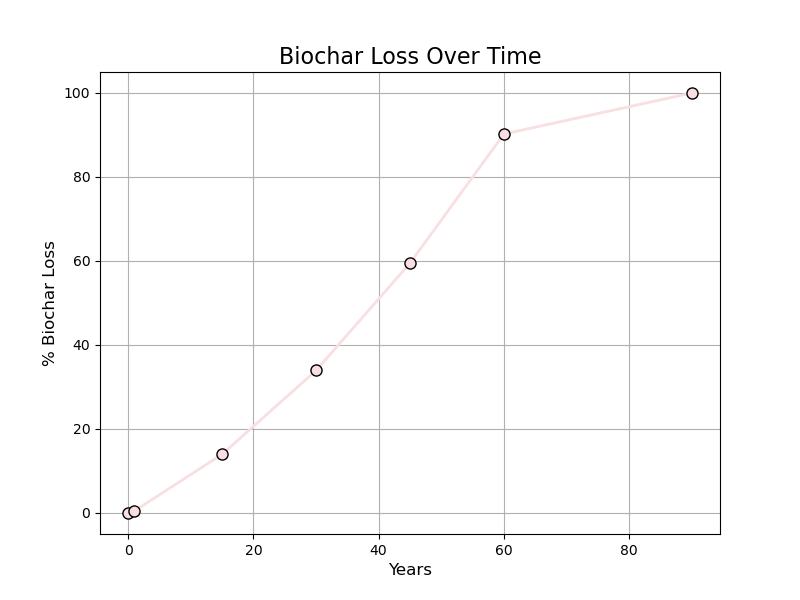
Figure A2 Percentage of biochar lost over time from a 1 m3 block of asphalt, assuming an abrasion rate of 0.5 mm/year and a biochar content of 5% by mass.
Because these calculations demonstrate complete loss of the labile fraction of biochar-amended asphalt within 100 years, 100% of the labile fraction of the biochar produced by the Project Proponent is deducted from the Credits issued under this Module.
Note that this framework does not take into account common maintenance practices for asphalt pavements, such as sealcoating and resurfacing, as these practices vary by region and specific application. Thus, in the absence of specific information regarding the use case and regional practices relevant to a Project, the most conservative scenario is used. Project Proponents may choose to provide additional information to conduct a Project-specific discount calculation.
13.0
Relevant Works
Footnotes
-
Kamini, G. P., Tee, K. F., Gimbun, J., & Chin, S. C. (2023). Biochar in cementitious material—A review on physical, chemical, mechanical, and durability properties. AIMS Materials Science, 10(3), 405-425. ↩
-
Gupta, S., Kua, H. W., & Low, C. Y. (2018). Use of biochar as carbon sequestering additive in cement mortar. Cement and Concrete Composites, 87, 110–129. ↩ ↩2
-
Wijeyawardana, P., Nanayakkara, N., Law, D., Gunasekara, C., Karunarathna, A., & Pramanik, B. K. (2023). Performance of biochar mixed cement paste for removal of Cu, Pb and Zn from stormwater. Environmental Research, 232, 116331. ↩
-
Barbhuiya, S., Bhusan Das, B., & Kanavaris, F. (2024). Biochar-concrete: A comprehensive review of properties, production and sustainability. Case Studies in Construction Materials, 20, e02859. ↩ ↩2 ↩3
-
Kushwah, S., Singh, S., Agarwal, R., Nighot, N., S., Kumar, R., Athar, H., & Naik B, S. (2024). Mixture of biochar as a green additive in cement-based materials for carbon dioxide sequestration. Journal of Materials Science: Materials in Engineering, 19, 27. ↩
-
Rashid, S., Raghav, A., Goyal, A., Danie Roy, A. B., & Singh, M. (2024). Biochar as a sustainable additive in cementitious composites: A comprehensive analysis of properties and environmental impact. Industrial Crops and Products, 209, 118044. ↩
-
Zou, S., Sham, M. L., Xiao, J., Leung, L. M., Lu, J. X., & Poon, C. S. (2024). Biochar-enabled carbon negative aggregate designed by core-shell structure: A novel biochar utilizing method in concrete. Construction and Building Materials, 449, 138507. ↩
-
Sanei, H., Rudra, A., Przyswitt, Z. M. M., Kousted, S., Sindlev, M. B., Zheng, X., Nielsen, S. B., & Petersen, H. I. (2024). Assessing biochar’s permanence: An inertinite benchmark. International Journal of Coal Geology, 281, 104409. ↩ ↩2 ↩3 ↩4 ↩5
-
Woolf, D., Lehmann, J., Ogle, S., Kishimoto-Mo, A. W., McConkey, B., & Baldock, J. (2021). Greenhouse gas inventory model for biochar additions to soil. Environmental Science & Technology, 55(21), 14795–14805. ↩
-
Wang, H., Nan, Q., Waqas, M., & Wu, W. (2022). Stability of biochar in mineral soils: Assessment methods, influencing factors and potential problems. Science of The Total Environment, 806, 150789. ↩ ↩2
-
Osman, A. I., Farghali, M., Dong, Y., Kong, J., Yousry, M., Rashwan, A. K., Chen, Z., Al-Fatesh, A., Rooney, D. W., & Yap, P.-S. (2024). Reducing the carbon footprint of buildings using biochar-based bricks and insulating materials: A review. Environmental Chemistry Letters, 22(1), 71–104. ↩ ↩2
-
Zhang, Y., He, M., Wang, L., Yan, J., Ma, B., Zhu, X., Ok, Y. S., Mechtcherine, V., & Tsang, D. C. W. (2022). Biochar as construction materials for achieving carbon neutrality. Biochar, 4(1), 59. ↩ ↩2 ↩3 ↩4
-
Rondón-Quintana, H. A., Reyes-Lizcano, F. A., Chaves-Pabón, S. B., Bastidas-Martínez, J. G., & Zafra-Mejía, C. A. (2022). Use of biochar in asphalts: Review. Sustainability, 14(8), 4745. ↩
-
Legan, M., Gotvajn, A. Ž., & Zupan, K. (2022). Potential of biochar use in building materials. Journal of Environmental Management, 309, 114704. ↩ ↩2 ↩3
-
Farfan, J., Fasihi, M., & Breyer, C. (2019). Trends in the global cement industry and opportunities for long-term sustainable CCU potential for Power-to-X. Journal of Cleaner Production, 217, 821–835. ↩
-
Moumin, G., Ryssel, M., Zhao, L., Markewitz, P., Sattler, C., Robinius, M., & Stolten, D. (2020). CO2 emission reduction in the cement industry by using a solar calciner. Renewable Energy, 145, 1578–1596. ↩
-
Praneeth, S., Saavedra, L., Zeng, M., Dubey, B. K., & Sarmah, A. K. (2021). Biochar admixtured lightweight, porous and tougher cement mortars: Mechanical, durability and micro computed tomography analysis. Science of The Total Environment, 750, 142327. ↩ ↩2
-
Zhou, X., Moghaddam, T. B., Chen, M., Wu, S., & Adhikari, S. (2020). Biochar removes volatile organic compounds generated from asphalt. Science of The Total Environment, 745, 141096. ↩ ↩2
-
Osman, A. I., Farghali, M., Dong, Y., Kong, J., Yousry, M., Rashwan, A. K., Chen, Z., Al-Fatesh, A., Rooney, D. W., & Yap, P.-S. (2024). Reducing the carbon footprint of buildings using biochar-based bricks and insulating materials: A review. Environmental Chemistry Letters, 22(1), 71–104. ↩
-
Loise, V., Calandra, P., Policicchio, A., Madeo, L., Oliviero Rossi, C., Porto, M., Abe, A., Agostino, R. G., & Caputo, P. (2024). The efficiency of bio-char as bitumen modifier. Heliyon, 10(1), e23192. ↩
-
Ma, F., Dai, J., Fu, Z., Li, C., Wen, Y., Jia, M., Wang, Y., & Shi, K. (2022). Biochar for asphalt modification: A case of high-temperature properties improvement. Science of The Total Environment, 804, 150194. ↩ ↩2
-
Thives, L. P., & Ghisi, E. (2017). Asphalt mixtures emission and energy consumption: A review. Renewable and Sustainable Energy Reviews, 72, 473–484. ↩ ↩2
-
Tutu, K. A., & Tuffour, Y. A. (2016). Warm-mix asphalt and pavement sustainability: A review. Open Journal of Civil Engineering, 06(02), 84–93. ↩
-
Yang, X., Mills-Beale, J., & You, Z. (2017). Chemical characterization and oxidative aging of bio-asphalt and its compatibility with petroleum asphalt. Journal of Cleaner Production, 142, 1837–1847. ↩ ↩2
-
Walters. (2014). Enhancing asphalt rheological behavior and aging susceptibility using bio-char and nano-clay. American Journal of Engineering and Applied Sciences, 7(1), 66–76. ↩
-
Zhou, Y., Shen, C., Wang, T., & Xue, Y. (2024). Inhibition effect of three types of biochar on volatile organic compounds from asphalt: Revealing chemical adsorption as the primary mechanism. Construction and Building Material, 411, 134322. ↩
-
O’Connor, J. (2004). Survey on actual service lives for North American buildings. Presented at Woodframe Housing Durability and Disaster Issues conference, Las Vegas, October 2004. ↩
-
RIBA. Lifespan. https://www.ribaj.com/culture/lifespan, Accessed 25/06/2024. ↩
-
DEFRA, UK Statistics on Waste. https://www.data.gov.uk/dataset/882186e7-97b0-4ad0-b253-e28607252f42/uk_statistics_on_waste ↩
-
National Asphalt Pavement Association, The carbon footprint of asphalt pavements. https://www.asphaltpavement.org/uploads/documents/Climate/NAPA-SIP109-TheCarbonFootprintOfAsphaltPavements-March2024.pdf ↩
-
Murph, D., Liu, J., & Liu, J. (2022). Designs of abrasion resistant and durable concrete pavements made with SCMs for cold climates. Journal of Transportation Engineering, Part B: Pavements, 148(2), 04022017. ↩ ↩2
-
Bae, S.-H., Chae, E., Park, Y.-S., Lee, S.-W., Yun, J.-H., & Choi, S.-S. (2024). Characteristics of tire-road wear particles (TRWPs) and road pavement wear particles (RPWPs) generated through a novel tire abrasion simulator based on real road pavement conditions. Science of The Total Environment, 944, 173948. ↩
-
WBC. (2023). World Biochar Certificate—Guidelines for a Sustainable Production of Biochar and its Certification. (Version 1.0). ↩
-
Zhong, Y., Igalavithana, A. D., Zhang, M., Li, X., Rinklebe, J., Hou, D., Tack, F. M. G., Alessi, D. S., Tsang, D. C. W., & Ok, Y. S. (2020). Effects of aging and weathering on immobilization of trace metals/metalloids in soils amended with biochar. Environmental Science: Processes & Impacts, 22(9), 1790–1808. https://doi.org/10.1039/D0EM00057D. ↩
-
Nguyen, T.-B., Sherpa, K., Bui, X.-T., Nguyen, V.-T., Vo, T.-D.-H., Ho, H.-T.-T., Chen, C.-W., & Dong, C.-D. (2023). Biochar for soil remediation: A comprehensive review of current research on pollutant removal. Environmental Pollution, 337, 122571. ↩
-
O’Connor, D., Peng, T., Zhang, J., Tsang, D. C. W., Alessi, D. S., Shen, Z., Bolan, N. S., & Hou, D. (2018). Biochar application for the remediation of heavy metal polluted land: A review of in situ field trials. Science of The Total Environment, 619–620, 815–826. ↩
-
Guo, M., Song, W., & Tian, J. (2020). Biochar-facilitated soil remediation: Mechanisms and efficacy variations. Frontiers in Environmental Science, 8, 521512. ↩
-
Sanei, H., Wojtaszek-Kalaitzidi, M., Schovsbo, N. H., Stenshøj, R., Zhou, Z., Schmidt, H.-P., Hagemann, N., Chiaramonti, D., Kiaitsis, T., Rudra, A., Lehner, A. J., Brown, R. W., Gill, S., Dorr, E., Kalaitzidis, S., Goodarzi, F., & Petersen, H. I. (in submission). Quantifying inertinite carbon in biochar. Biomass and Bioenergy. ↩
-
Yaro, N. S. A., Sutanto, M. H., Habib, N. Z., Usman, A., Kaura, J. M., Murana, A. A., Birniwa, A. H., & Jagaba, A. H. (2023). A comprehensive review of biochar utilization for low-carbon flexible asphalt pavements. Sustainability, 15(8), 6729. ↩
-
Zhang, Y., He, M., Wang, L., Yan, J., Ma, B., Zhu, X., Ok, Y. S., Mechtcherine, V., & Tsang, D. C. W. (2022). Biochar as construction materials for achieving carbon neutrality. Biochar, 4(1), 59. ↩
-
Wang, H., Nan, Q., Waqas, M., & Wu, W. (2022). Stability of biochar in mineral soils: Assessment methods, influencing factors and potential problems. Science of The Total Environment, 806, 150789. ↩
-
Spokas, K. A., Novak, J. M., Masiello, C. A., Johnson, M. G., Colosky, E. C., Ippolito, J. A., & Trigo, C. (2014). Physical disintegration of biochar: An overlooked process. Environmental Science & Technology Letters, 1(8), 326–332. ↩
-
Xie, Y., Li, C., Chen, H., Gao, Y., Vancov, T., Keen, B., Van Zwieten, L., Fang, Y., Sun, X., He, Y., Li, X., Bolan, N., Yang, X., & Wang, H. (2024). Methods for quantification of biochar in soils: A critical review. CATENA, 241, 108082. ↩
-
Kazemian, M., & Shafei, B. (2023). Carbon sequestration and storage in concrete: A state-of-the-art review of compositions, methods, and developments. Journal of CO2 Utilization, 70, 102443. ↩ ↩2
-
Liu, Z., & Meng, W. (2021). Fundamental understanding of carbonation curing and durability of carbonation-cured cement-based composites: A review. Journal of CO2 Utilization, 44, 101428. ↩
-
Glasser, F. P., Marchand, J., & Samson, E. (2008). Durability of concrete—Degradation phenomena involving detrimental chemical reactions. Cement and Concrete Research, 38(2), 226–246. ↩
-
Lothenbach, B., Saout, G. L., Gallucci, E., & Scrivener, K. (2008). Influence of limestone on the hydration of Portland cements. Cement and Concrete Research, 38(6), 848–860. ↩
-
Palandri, J. L., & Kharaka, Y. K. (2004). A compilation of rate parameters of water-Mineral interaction kinetics for application to geochemical modeling. USGS-Report (2004-1068), Menlo Park, California, USA. ↩
-
Nicoleau, L., Nonat, A., & Perrey, D. (2013). The di- and tricalcium silicate dissolutions. Cement and Concrete Research, 47, 14–30. ↩
-
Holmes, N., Tyrer, M., West, R., Lowe, A., & Kelliher, D. (2022). Using PHREEQC to model cement hydration. Construction and Building Materials, 319, 126129. ↩
-
Peng, C., Crawshaw, J. P., Maitland, G. C., & Trusler, J. P. M. (2015). Kinetics of calcite dissolution in CO2-saturated water at temperatures between (323 and 373)K and pressures up to 13.8MPa. Chemical Geology, 403, 74–85. ↩
-
Payus, C. M., Jikilim, C., & Sentian, J. (2020). Rainwater chemistry of acid precipitation occurrences due to long-range transboundary haze pollution and prolonged drought events during southwest monsoon season: Climate change driven. Heliyon, 6(9), e04997. ↩
-
Foureaux, A. F. S., Moreira, V. R., Lebron, Y. A. R., Santos, L. V. S., & Amaral, M. C. S. (2020). Direct contact membrane distillation as an alternative to the conventional methods for value-added compounds recovery from acidic effluents: A review. Separation and Purification Technology, 236, 116251. ↩
Contributors

Xueya Lu, Ph.D.

Robert Brown, Ph.D.

Isometric
Biochar Storage in the Built Environment © 2026 Isometric HQ Ltd is licensed under CC BY-NC-ND 4.0